
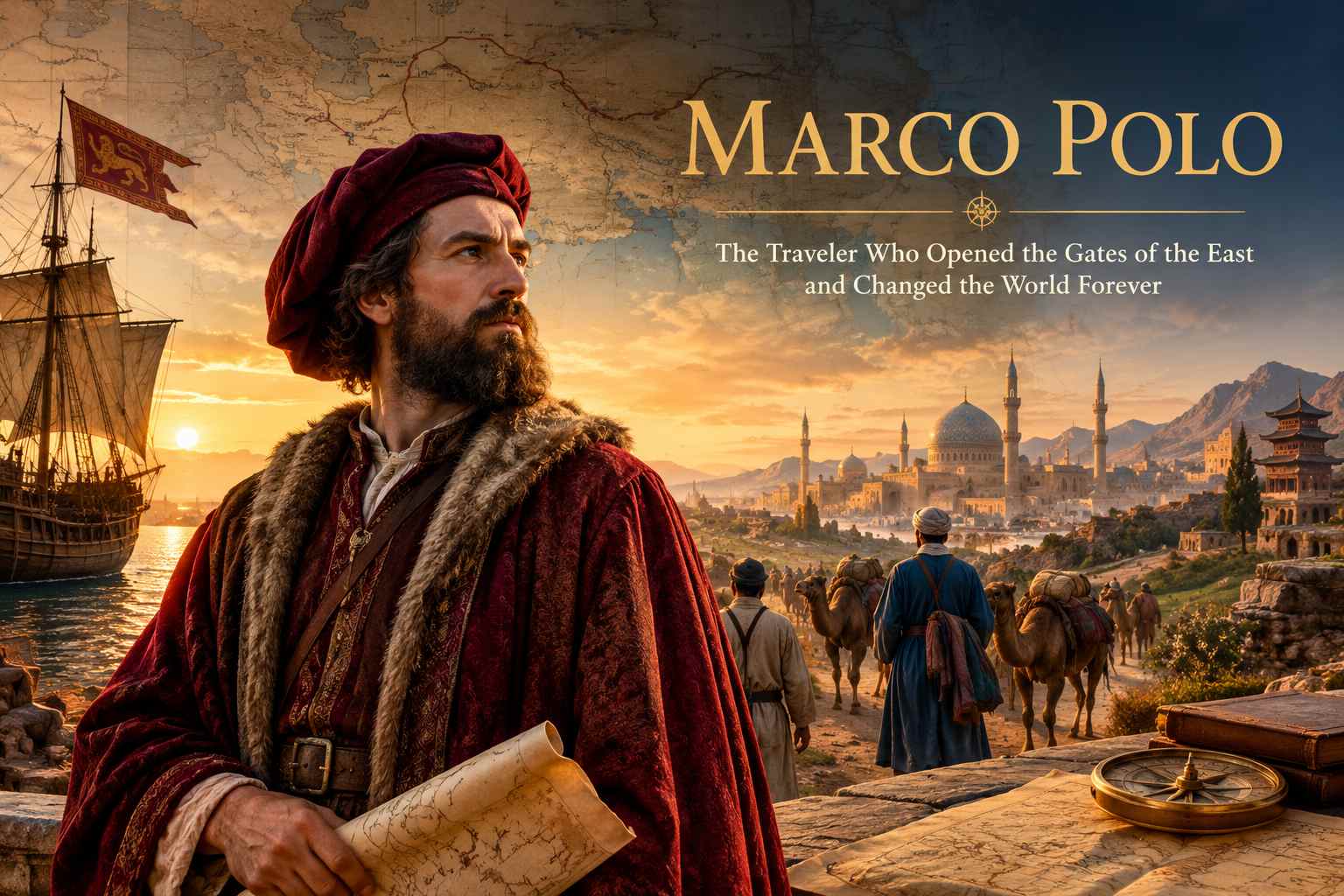
"arco Polo: The Traveler Who Opened the Gates of the East and Changed the World Forever At the dawn of the 14th century, as the elderly merchant Marco Polo lay on his deathbed in Venice, gathered friends and priests implored him to save his soul. They urged him to retract the extraordinary tales from his book—stories of sprawling cities with millions of inhabitants, paper money replacing gold, black stones that burned like timber, and palaces overlaid with pure silver. "
Marco Polo: The Traveler Who Opened the Gates of the East and Changed the World Forever
At the dawn of the 14th century, as the elderly merchant Marco Polo lay on his deathbed in Venice, gathered friends and priests implored him to save his soul. They urged him to retract the extraordinary tales from his book—stories of sprawling cities with millions of inhabitants, paper money replacing gold, black stones that burned like timber, and palaces overlaid with pure silver. They regarded these accounts as the product of a fevered imagination, if not outright fabrications. Marco looked at them and uttered words that still echo through history:
"I have not told half of what my eyes have seen, for I knew that no one would believe me."
Marco Polo was far more than a Venetian trader venturing eastward in search of silk and spices. He was the living bridge between two advanced civilizations that had existed for centuries in mutual ignorance. His 24,000-kilometer overland and maritime odyssey, spanning twenty-four years, shattered medieval myths about monsters lurking at the edges of the known earth, replacing them with empirical geography, anthropology, and Asian commerce. His book,known as Il Milione, became the world's first global travel bestseller—and two centuries later, directly inspired Christopher Columbus to sail west into the Atlantic.
Origins: The Question of Heritage, Korčula Island, and the Venetian Republic
The debate surrounding the genealogical origins of the Polo family remains one of the most intriguing historical questions of the late medieval Mediterranean. While Italian historiography celebrates him as a native Venetian citizen,deep-rooted eastern Adriatic tradition and substantial historical documentation tie the lineage of the Polo family to the Dalmatian island of Korčula.
The Dalmatian Connection: The De Polo Lineage on Korčula
In the 13th century, around the time Marco was born (circa 1254), the Adriatic Sea was the logistical spine of the Venetian maritime empire (Stato da Màr). The island of Korčula, with its strategic harbor and dense pine forests prized for shipbuilding timber, stood as one of Venice's indispensable naval bastions.
In the historical archives, municipal registers, and notarial records of Korčula, the surname De Polo appears consistently across centuries. In the fortified Old Town of Korčula, a Gothic stone tower and residence stand preserved to this day, traditionally identified as the ancestral home of the Polo family before their relocation across the sea to Venice. The family coat of arms of the Korčulan De Polos features four waterbirds (polojke), an explicit heraldic reference to the family name.
While international commerce drew the family into the political heart of the Venetian Republic, their connection to the eastern Adriatic coast endured. Later in life, Marco would find himself commanding a warship in the waters off Korčula, where his life's journey came full circle in dramatic fashion.
The Merchant Lineage: Niccolò and Maffeo Polo
Marco was not the first of his bloodline to traverse the Silk Road. The foundations of his life were laid by his father,Niccolò, and his uncle, Maffeo Polo. They belonged to the Venetian merchant patriciate—men who recognized that the greatest commercial profits lay not in reselling Mediterranean cargo, but in establishing direct access to trade routes in the Far East.
In 1260, when Marco was only six years old in Venice, Niccolò and Maffeo departed the Venetian merchant quarter in Constantinople, anticipating a political coup and the restoration of the Byzantine Empire. They sailed to Crimea and traveled up the Volga River into the heartland of the Golden Horde. Trade opportunities and regional warfare pushed them progressively eastward through Bukhara in modern Uzbekistan, until in 1266 they reached the winter capital of the Mongol Empire, Khanbaliq (modern Beijing).
There they were granted an audience with Kublai Khan, grandson of Genghis Khan and supreme ruler of the largest contiguous land empire in human history. Intrigued by European culture, Christian theology, and the mercantile acumen of the Polo brothers, the Khan dispatched them back to the Pope with an official embassy, requesting one hundred Christian scholars to instruct his court in Western learning, alongside holy oil from the Holy Sepulchre in Jerusalem. The brothers returned to Venice in 1269, meeting fifteen-year-old Marco for the first time following the death of his mother during their absence.
Departure into the Unknown: An Epic Three-and-a-Half-Year Journey (1271–1275)
When Niccolò and Maffeo set out in 1271 to return to the court of the Great Khan, they brought the seventeen-year-old Marco with them. They were unable to secure the hundred requested scholars; newly elected Pope Gregory X could provide only two Dominican friars, who soon turned back out of fear as armed conflicts flared across the Levant. The three Polos pressed forward alone, carrying only papal diplomatic letters and consecrated oil from Jerusalem.
Across the Levant, Armenia, and Persia
Their journey took them through the ancient ports of Acre and Hormuz, where young Marco proved an extraordinarily observant chronicler:
Lesser Armenia and Mount Ararat: He noted the mountain where, according to tradition, Noah's Ark came to rest, as well as the surface petroleum seepages around Baku (modern Azerbaijan), describing a fountain "from which oil gushes in such abundance that a hundred shiploads might be loaded at once, used for fuel and anointing men and camels."
The Strait of Hormuz: The original plan called for chartering vessels at the Persian port of Hormuz to sail directly to China. However, upon inspecting the local dhows—constructed without iron nails and stitched together with coconut-fiber cordage—they judged them seaworthy hazards and made the fateful decision to proceed entirely overland across some of the world's most inhospitable terrains.
Traversing the Pamir Mountains and the Gobi Desert
Ascending toward the Roof of the World pushed the travelers to their physical limits. Marco fell severely ill, likely from malaria or extreme exhaustion, forcing the party to pause for nearly a year in the highland valleys of Badakhshan (modern northeastern Afghanistan), where the cool mountain air restored his health.
Next came the ascent across the high Pamir Plateau, an alpine expanse so lofty and cold that Marco recorded that "fires do not burn with the same brilliance, nor do they give out the same heat as in the lowlands, and food cooks with difficulty." There he documented the large wild mountain sheep with sweeping spiral horns, a species modern zoology later named in his honor: Ovis ammon polii (Marco Polo sheep).
Beyond the Pamirs lay the desolate expanses of the Taklamakan Desert and the fringes of the Gobi Desert. The caravan spent a grueling month crossing shifting dunes, battling violent sandstorms and psychological mirages. Marco noted eerie desert legends of spirits calling travelers by their real names, luring stragglers away from the caravan trail to their deaths among the sands.
After three and a half years of continuous trekking, riding, and survival, in the spring of 1275, the exhausted travelers arrived at Shangdu (the imperial summer capital of Kublai Khan, later celebrated in Western literature as Xanadu).
At the Court of the Great Khan: Seventeen Years in the Heart of the Empire
Kublai Khan received the Polo brothers with imperial ceremony, and young Marco captured his attention. Unlike many contemporary Westerners who viewed foreign cultures through narrow religious prejudice, Marco exhibited linguistic talent and cultural adaptability. In short order, he mastered four languages (including Mongolian and Persian) along with the administrative script of the Mongol chancery.
Marco as Imperial Envoy and Inspector
The Mongol Yuan rulers distrusted the ethnic Han scholar-gentry of the conquered Song Dynasty, yet lacked sufficient imperial administrators of their own to oversee such a vast realm. Trusted foreigners like the Polos proved valuable assets.
Kublai Khan appointed Marco Polo as a special roving commissioner and imperial inspector. His assignments sent him across distant provinces—including parts of modern Tibet, Yunnan, Myanmar, and southern China—to report directly to the throne:
Marco quickly recognized that the Emperor was bored by dry fiscal ledgers; the Khan wanted vivid narratives detailing regional ethnography, strange customs, natural resources, and political developments.
Marco became an imperial favorite and, according to his own accounts, served for three years as the governor of the major administrative city of Yangzhou.
Technological and Social Sophistication: What Marco Witnessed in China
The contrast between medieval Western Europe and Yuan Dynasty China was stark. While prominent European capitals like Paris and London had modest populations of a few tens of thousands, lacked organized sanitation, and relied exclusively on metallic bullion, Marco Polo encountered an urban civilization centuries ahead of the West:
Hangzhou (Kinsay) — The City of Heaven: Marco described it as the greatest city on earth, with a circuit of roughly a hundred miles, twelve thousand stone bridges arched high enough for masted vessels to pass beneath,paved avenues, public bathhouses, and an expansive freshwater lake bordered by aristocratic palaces. The metropolis featured municipal trash removal, fire brigades, and vast markets stocked with exotic provisions.
Paper Currency (Fiat Money): Marco observed with disbelief how the Great Khan had the inner bark of the mulberry tree manufactured into sheets of paper, stamped with the official imperial seal, and declared sovereign legal tender. He noted that these paper notes purchased silk, gold, gemstones, and livestock, and that refusing them was punishable by death—an economic system centuries ahead of European central banking.
Combustible Black Stones (Coal): He described how people in northern China quarried black stones from mountainsides that burned longer and hotter than wood, sustaining hot water baths for the population through freezing winters.
The Imperial Postal Relay Network (Örtöö): A sprawling web of post houses situated every 25 to 30 miles allowed couriers to cover hundreds of miles in a day. Messengers wore bells on their belts so station attendants could hear their approach and ready fresh mounts before the incoming rider had dismounted.
Flame-Resistant Asbestos and Explosives: He documented minerals woven into heat-resistant cloth (asbestos fibers) as well as military applications of explosive incendiaries formulated from saltpeter and sulfur.
The Journey Home: An Epic Maritime Expedition
As decades passed, the Polos grew wealthy, yet they recognized their precarious political footing. Kublai Khan was entering his late seventies; his eventual death would almost certainly leave favored foreign courtiers vulnerable to retaliatory purges by hostile factions. Yet the Khan repeatedly rejected their petitions to return to Europe, valuing them as trusted advisors.
Their opportunity came in 1292. Arghun Khan, ruler of the Ilkhanate in Persia and a grandnephew of Kublai, had lost his primary wife. In honoring her dying wish, his envoys arrived in Khanbaliq seeking a bride from her ancestral Mongol clan. Seventeen-year-old Princess Kököchin was chosen. Because civil unrest had severed overland routes across Central Asia, the bridal escort had to travel by sea. The Mongol envoys were inexperienced in blue-water navigation and successfully petitioned Kublai Khan to allow the seafaring Polos to command the fleet. The Khan granted permission.
Through the Hazards of the Southern Oceans
The Great Khan supplied an armada of fourteen large, four-masted ocean vessels, crewed by several hundred sailors and passengers, issuing the Polos the imperial golden tablet (paiza) granting them royal protection and supplies throughout Mongol territories.
Setting sail from Quanzhou, the fleet skirted the coasts of Vietnam, anchored for five months on the island of Sumatra waiting out the seasonal monsoons to avoid pirate fleets and open-sea squalls, and traversed the Bay of Bengal toward Sri Lanka and the coasts of India. Marco meticulously detailed pearl diving in the Gulf of Mannar, ascetics, and regional funeral rites.
The voyage proved perilous: of more than six hundred passengers and crew, only eighteen individuals survived the passage to Persia, among them Princess Kököchin and the three Polos. Upon arrival, they discovered that Arghun Khan had already died, and the princess was married instead to his son, Ghazan.
Receiving news in Persia that Kublai Khan had passed away in 1294, the Polos realized their ties to the East were severed. Sailing across the Black Sea through Trebizond to Constantinople, Marco, Niccolò, and Maffeo entered the Venetian Lagoon in 1295, after twenty-four years away.
Return to Venice: Skepticism and the Unveiling of Jewels
According to the account preserved by 16th-century Venetian biographer Giovanni Battista Ramusio, when the travelers arrived at their family estate in the parish of San Giovanni Crisostomo, their relatives failed to recognize them.
They arrived clad in tattered, coarse Mongol garments, their complexions weathered by decades of desert sun and sea spray. They spoke Venetian with a heavy foreign cadence, interspersing words of Mongol and Persian. Initially, their own relatives refused them entry.
To prove their identity, the Polos hosted an elaborate banquet for the Venetian patriciate:
Over the course of the evening, the hosts changed their attire multiple times, each time appearing in richer robes of crimson silk and damask, presenting the discarded garments as gifts to the servants.
When the feast concluded, Marco brought out the ragged, threadbare Mongol coats they had worn upon arrival.Before the astonished assembly, they took tailors' knives and ripped open the seams and quilted linings.
Cascades of rubies, emeralds, sapphires, diamonds, and raw turquoise—collected and concealed from highwaymen over two decades—spilled onto the banquet tables.
All doubts vanished instantly: the forgotten castaways were recognized as wealthy citizens of the Republic.
The Battle of Korčula (1298) and Captivity in Genoa
The peace of Marco's return was brief. The maritime rivalry between the Mediterranean's dominant naval powers—Venice and Genoa—erupted into open war over trade supremacy in the Levant and the Black Sea.
Clash of Superpowers in the Eastern Adriatic
On September 8, 1298, in the waters off Korčula and the Pelješac Peninsula, the two republics fought one of the largest naval engagements of the medieval era: the Battle of Korčula.
The Venetian fleet, commanded by Admiral Andrea Dandolo, mustered 95 galleys.
The Genoese armada, under Lamba Doria, fielded 78 galleys, employing an effective reserve strategy anchored behind the headland with the prevailing wind.
Marco Polo personally financed the outfitting of a Venetian war galley and commanded it in the line of battle. The engagement ended in a catastrophic defeat for Venice: 85 Venetian vessels were captured or destroyed, Admiral Dandolo died in captivity, and seven thousand Venetians were transported to Genoa as prisoners of war. Among them was forty-four-year-old Marco Polo.
Captivity in the cells of what is today the Palazzo San Giorgio in Genoa ensured Marco Polo's lasting fame. His cellmate was Rustichello da Pisa, a romance writer and chivalric chronicler captured during Genoa's victory over Pisa at the Battle of Meloria in 1284.
Rustichello was an author writing in the literary Franco-Italian vernacular (franco-italien). Recognizing the significance of Marco's oral memoirs, Rustichello encouraged him to send for his personal trade ledgers and notes preserved in Venice.
Throughout 1298 and 1299, Marco dictated his memoirs while Rustichello transcribed and shaped the narrative. The work was initially titled Devisement du Monde (The Description of the World), later earning historical renown as Il Milione (derived from his family nickname, Emilione) or The Travels of Marco Polo.
Anatomy of a Masterwork: How "Il Milione" Altered Geography
Following the signing of a peace treaty between Genoa and Venice in 1299, Marco Polo was released, carrying the completed manuscript. Long before Gutenberg's printing press, the text was transcribed by hand into Latin, Tuscan,Venetian, German, and French, becoming one of the most widely circulated secular texts of the Middle Ages, with roughly 150 manuscript copies surviving today.
Geographic Feature | Pre-Marco Polo (Medieval Cartographic Myth) | Post-Marco Polo (Empirical Geography) |
|---|---|---|
Eastern Rim of the Earth | Inhabited by mythical creatures, cynocephali, and the tribes of Gog and Magog. | Advanced civilizations, urban centers, and merchant shipping networks. |
China (Cathay & Mangi) | A nebulous land of silk with undefined borders and political structures. | Divided into northern and southern provinces with details on tax yields and civic governance. |
Trade Networks | Confined to middlemen ports across the Levant and Red Sea. | Mapped out the Silk Road trade corridors and Indian Ocean sea lanes. |
Monetary Architecture | Exclusively metallic bullion (gold, silver, and base alloys). | First documentation of state-backed paper currency and centralized fiscal systems. |
Energy Sources | Wood timber, charcoal, and draught animals. | First European accounts of coal deposits ("black stones") and surface petroleum. |
Literary and Empirical Methodology
Unlike contemporary pilgrimage accounts heavy with religious allegory and theological musings, Marco Polo wrote with the precision of a merchant administrator:
Distances were calculated systematically in days of travel,
Commodities and outputs were enumerated (pepper, silk, rubies, ivory, camphor),
Religions were documented without polemical censure (recording Islam, Buddhism, Nestorian Christianity, and local customs),
Mongol military tactics, mounted archery, and logistical systems were analyzed objectively.
His text provided Europe with its first secular, empirical overview of the Asian continent.
Final Years and Enduring Legacy
Returning to Venice, Marco married Donata Badoer, daughter of an established merchant family, and raised three daughters: Fantina, Bellella, and Moreta. He purchased a home in San Giovanni Crisostomo, living out his years overseeing commercial ventures and minor shipping investments.
He remained in Venice for the rest of his life. Local acquaintances often sought him out, while neighborhood youths followed him through the calli calling out: "Messer Marco, tell us another of your thousand tales!"
Marco Polo died on January 8, 1324, near the age of seventy. He was laid to rest in the Church of San Lorenzo; his tomb was lost during 16th-century architectural renovations. In his last will and testament, he granted freedom to Peter,his Tartar servant brought back from Asia, bequeathing him an endowment.
Catalyst for the Age of Discovery
Marco Polo's impact on early modern navigation is well documented. Fra Mauro’s celebrated Mappa Mundi of 1450 and Martin Behaim’s 1492 Erdapfel globe drew their depictions of East Asia directly from his coordinates and descriptions.
His most consequential reader was Genoese mariner Christopher Columbus:
Columbus possessed a personal Latin copy of Marco Polo’s travels,
The volume, preserved in the Biblioteca Colombina in Seville, contains hundreds of handwritten marginal annotations in Columbus’s own script,
When Columbus sailed west in 1492, he carried letters of introduction from the Spanish monarchs addressed to the Great Khan of Cathay, aiming to reach the ports of Kinsay and the island of Cipangu (Japan) described by Marco Polo. He encountered the Americas instead.
Chronology of Travel and Historical Milestones
Era / Date | Geographic Anchor / Milestone | Historical Significance |
|---|---|---|
c. 1254 | Birth of Marco Polo (Venice / traditionally Korčula). | Beginning of the merchant lineage. |
1260–1269 | First voyage of Niccolò and Maffeo Polo to China. | Initial European diplomatic contact with Kublai Khan. |
1271 | Seventeen-year-old Marco departs Acre with his father and uncle. | Commencement of the twenty-four-year Asian odyssey. |
1271–1275 | Crossing of Persia, the Pamir Mountains, and the Gobi Desert. | Mapping interior overland routes across Central Asia. |
1275 | Arrival at Shangdu before Emperor Kublai Khan. | Beginning of seventeen years in service to the Mongol court. |
1275–1292 | Service as imperial envoy, inspector, and regional administrator. | Compiling observations of Asian economy, geography, and culture. |
1292–1294 | Naval escort of Princess Kököchin across the Indian Ocean to Persia. | Navigation of maritime passages across Southeast Asia and India. |
1295 | Return of the Polo party to Venice after twenty-four years. | Reintroduction of Eastern knowledge, wealth, and trade intelligence. |
Sept 8, 1298 | Battle of Korčula; Marco Polo captured by Genoese naval forces. | Naval clash between Venice and Genoa in Adriatic waters. |
1298–1299 | Imprisonment in Genoa; dictation of memoirs to Rustichello da Pisa. | Composition of the foundational manuscript of Il Milione. |
Jan 8, 1324 | Death of Marco Polo in Venice. | Conclusion of the medieval era's most famous explorer's life. |
Cultural Resonance: Why His Name Endures
The name of Marco Polo remains a worldwide metaphor for global exploration and cross-cultural discovery:
Astronomy and Science: Asteroid 2945 Zanstra was renamed in his honor, alongside the lunar crater Marco Polo. The wild sheep of the Pamirs preserves his name scientifically: Ovis ammon polii.
Aviation and Transport: Venice’s international airport is formally designated Aeroporto di Venezia Marco Polo.
On Korčula Island: The town of Korčula maintains an active civic identity celebrating this heritage, hosting the Marco Polo Museum, heritage centers, and performances of the traditional Moreška sword dance recalling Mediterranean maritime clashes.
Marco Polo was neither an armed conquistador nor an ideological proselytizer. He was an empirical observer who recorded Buddhist monks, Mongol cavalrymen, Persian astrologers, and Chinese merchants with curious detachment.His enduring achievement was not merely introducing Asia to a secluded Europe, but demonstrating that beyond the horizon lived civilizations whose knowledge, arts, and governance rivaled anything in the Western world.
Archival Repositories and Primary Scholarly Sources
Town Museum of Korčula (Gradski muzej Korčula) – Official cultural institution preserving archival documentation, genealogical records, and artifacts on the Polo lineage in Dalmatia and the 1298 Battle of Korčula.
Biblioteca Nazionale Marciana, Venice – Repository of historic Venetian manuscripts, Marco Polo’s last will and testament, and early transcriptions of Il Milione.
Miroslav Krleža Institute of Lexicography – Croatian Encyclopedia: Polo, Marko – Authoritative biographical reference and historiographical analysis.
The British Library – The Travels of Marco Polo – Digital collections of illuminated medieval manuscripts illustrating the dissemination of Polo’s geographical observations.
Bibliothèque nationale de France (BnF) – Digitized collection preserving Le Livre des Merveilles (Français 2810), one of the most celebrated 15th-century illuminated copies of Polo’s work.
Columbia University – The Mongols in World History – Academic resource evaluating the governance of Kublai Khan and foreign diplomats in the Yuan Dynasty.
Written by
CroatiaBest
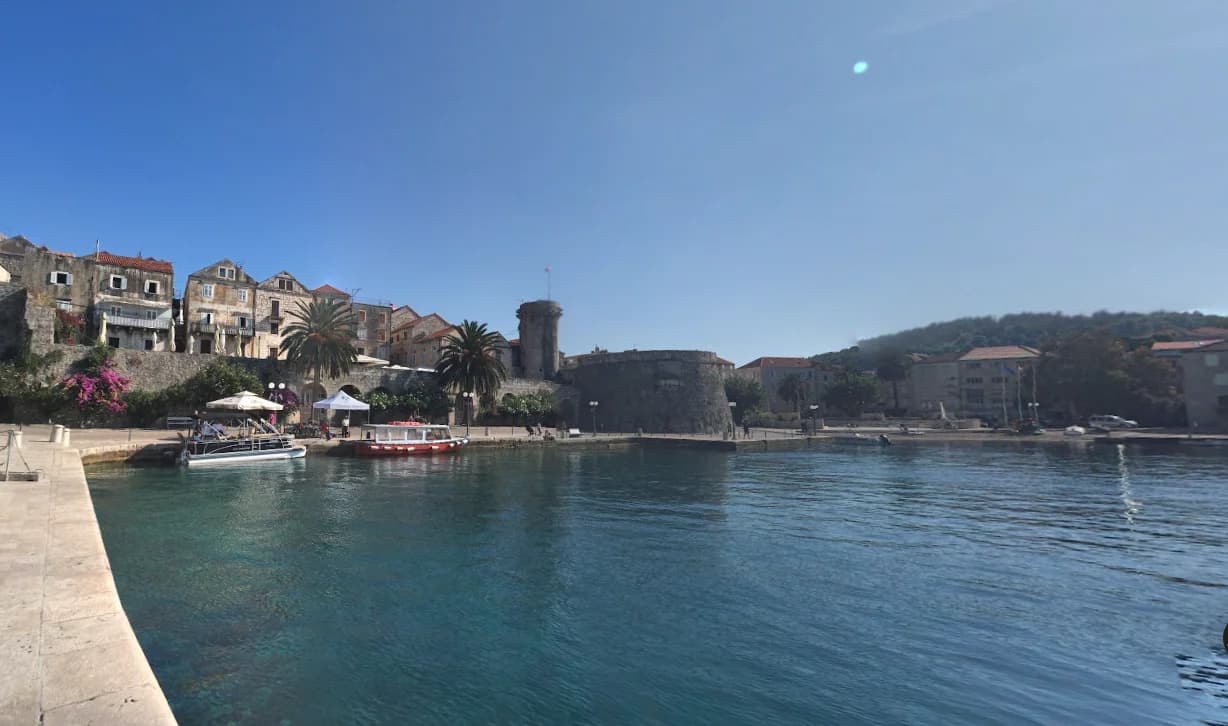
Explore Island Otok Korčula
Korčula is an island of rich tradition, lush vegetation, and stunning medieval architecture. It is often called "Little Dubrovnik" due to the impressive city walls that surround the old town of Korčul...
You might also be interested in

Croatia Worth Visiting: Historical, Natural, and Social Wonders of Europe’s Top Destination
When mentioning a country that combines a thousand-year history, incredible natural diversity, and a unique social lifestyle within a relatively small geographic space, Croatia rightfully stands at the very top of world tourism and transit maps. Located at the crossroads of Central Europe, the Mediterranean, and Southeast Europe, this country has been built over centuries as a bridge between different civilizations, cultures, and trade routes. Whether you are a passionate explorer of ancient ruins, a lover of untouched nature, a foodie in search of authentic flavors, or a traveler wanting to feel the relaxed Mediterranean spirit, Croatia offers an experience that goes beyond conventional tourism.

7 Attempts to Conquer and Subjugate Dubrovnik: From Medieval Wars to Great Serbian Aggression
Subscribe
The best stories about Croatia straight to your inbox every Sunday.