
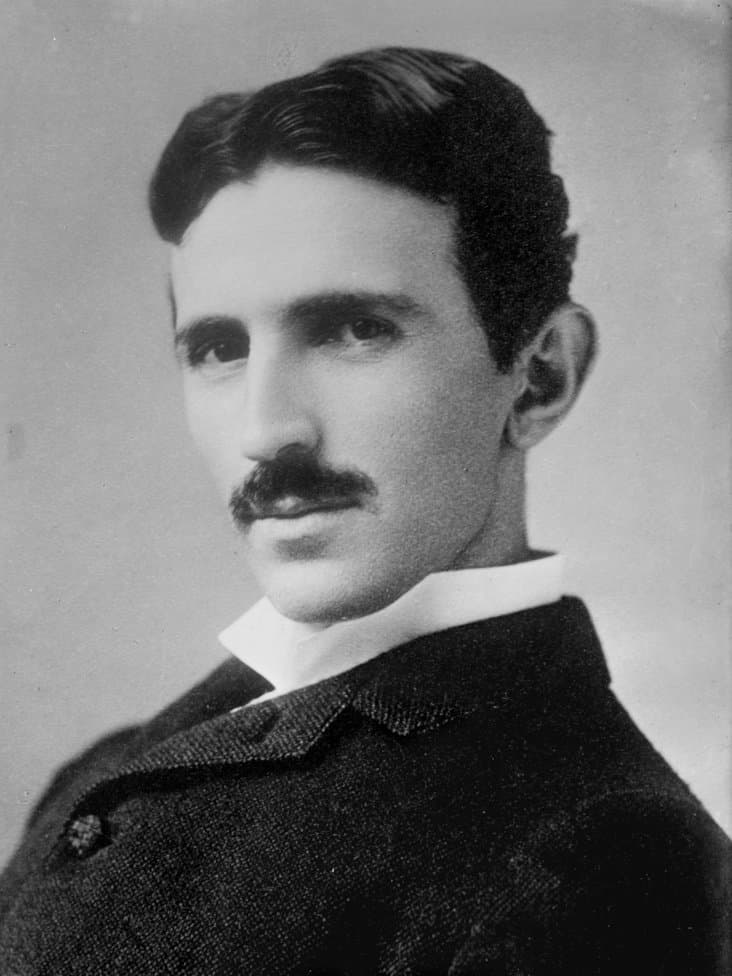
"Nikola Tesla stands undeniably among the most brilliant minds in human history. He was a visionary physicist, mathematician, and electrical engineer whose patents and theoretical breakthroughs drove the Second Industrial Revolution, ushered humanity into the electrical age, and established the foundation for modern wireless technologies. While his contemporaries pursued short-term commercial returns, Tesla operated decades ahead of his era, conceptualizing innovations that directly anticipated smartphones, the internet, unmanned aerial vehicles, and planetary-scale energy distribution."
Nikola Tesla stands undeniably among the most brilliant minds in human history. He was a visionary physicist, mathematician, and electrical engineer whose patents and theoretical breakthroughs drove the Second Industrial Revolution, ushered humanity into the electrical age, and established the foundation for modern wireless technologies. While his contemporaries pursued short-term commercial returns, Tesla operated decades ahead of his era, conceptualizing innovations that directly anticipated smartphones, the internet, unmanned aerial vehicles, and planetary-scale energy distribution.
His life journey—from a modest upbringing in the rugged landscape of Lika to the elite scientific circuits of New York City and his historic partnership with George Westinghouse—remains an enduring testament to relentless intellectual curiosity, uncompromising dedication to technological progress, and a visionary commitment to the advancement of human civilization.
Early Life, Ancestry, and Formative Years in Lika
Nikola Tesla was born precisely at midnight between July 9 and July 10, 1856, in the village of Smiljan near Gospić, within the Austrian Military Frontier of the Habsburg Monarchy. According to family accounts, a violent thunderstorm raged over Lika during his delivery. Frightened by the lightning strikes, the midwife remarked to his mother that the newborn would be a "child of darkness," to which his mother prophetically responded: "No, he will be a child of light."
Family Roots and His Mother's Inventive Mind
Tesla's father, Milutin Tesla, was an Eastern Orthodox priest, an educated scholar, poet, and lover of natural sciences who maintained an extensive personal library where young Nikola spent hours reading. Milutin expected his son to enter the priesthood, but Nikola was drawn to natural phenomena.
Tesla attributed his inventive genius and photographic memory primarily to his mother, Georgina (Đuka) Mandić. Although she had no formal schooling—common for women in rural regions at the time—Đuka possessed a photographic memory, reciting entire volumes of traditional epic poetry, and had a natural talent for designing household apparatuses, weaving looms, and manual kitchen appliances. Tesla repeatedly stressed that he inherited his intuitive visualization abilities and mechanical creativity from his mother.
Education in Gospić and Karlovac
Tesla completed his elementary schooling in Smiljan and Gospić, where the family relocated following the tragic death of Nikola's older brother, Dane—an event that deeply affected the family.
Between 1870 and 1873, he attended the Imperial and Royal Higher Real Gymnasium in Rakovac near Karlovac (now the Karlovac Gymnasium). In Karlovac, physics professor Martin Sekulić introduced Tesla to practical electrical demonstrations. Observing experiments with electrostatic charges and Leyden jars, Tesla was captivated by electricity. He completed the rigorous four-year curriculum in three years, aided by his ability to perform complex calculus, differential equations, and mental geometry without paper or mathematical tables.
Upon returning to Gospić after graduation, Tesla contracted cholera, remaining bedridden and near death for nine months. During a critical moment of illness, he secured a pledge from his father: if he survived, he would not be forced into the priesthood, but allowed to pursue engineering. Tesla recovered, and his father honored the commitment.
Patriotic Ties: Identity and Connection to Croatia
Historical records document Tesla's relationship with his birthplace and national identity. Although born into an ethnic Serb family and later naturalized as a citizen of the United States, Tesla consistently viewed and publicly declared Croatia—the country where he was born, raised, and educated—as his homeland.
The 1892 Visit to Zagreb and the Vision for Electrification
The most prominent documentation of his attachment to his native land occurred in May 1892. Having achieved international scientific celebrity following acclaimed lectures in London and Paris, Tesla traveled to Europe to visit his terminally ill mother in Gospić.
Upon the formal invitation of Zagreb Mayor Milan Amruš, Tesla arrived in Zagreb on May 24, 1892. Addressing municipal officials, engineers, and civic leaders in the Old City Hall in Upper Town, he advocated for harnessing Croatia's water resources to power a national grid, stating:
"As a native son of this country, I consider it my duty to help the city of Zagreb in every way with my advice and my actions."
Tesla proposed constructing a hydroelectric generating plant on the Plitvice Lakes or along the Sava River to supply Zagreb with alternating current. His visit provided the momentum for the electrification of Croatia. Three years later, in August 1895, the Jaruga Hydroelectric Power Plant on the Krka River near Šibenik began commercial operations—opening as the first complete alternating current power system in Europe and the second in the world (commissioned just two days after the Niagara Falls project), illuminating Šibenik via Tesla's multi-phase patents.
The Historic Telegram to Vladko Maček
Further documentation of his perspective on his heritage is preserved in an exchange from May 1936. Dr. Vladko Maček, leader of the Croatian Peasant Party, sent Tesla a congratulatory telegram for his 80th birthday, honoring him as a native luminary.
Tesla sent his reply from New York:
"Thank you for your highly esteemed congratulations and honors. I am equally proud of my Serb origin and my Croatian homeland. Long live all Yugoslavs. Nikola Tesla."
Tesla consistently rejected regional divisions, viewing his work in universal terms while maintaining respect for his native roots.
Higher Education and the Epiphany in Budapest
In 1875, Tesla enrolled at the Imperial and Royal Technical College in Graz on a Military Frontier scholarship. He maintained an intense academic regimen: studying from 3:00 AM until 11:00 PM, passing nearly twice as many examinations during his first year as required by the university curriculum.
The Dispute with Professor Pöschl
A critical intellectual confrontation occurred during a lecture by physics professor Jakob Pöschl, who was demonstrating a direct current (DC) Gramme dynamo equipped with mechanical brushes and a commutator. The machine produced heavy sparking, mechanical friction, and energy losses during operation.
Tesla suggested to the class that the brushes and commutator could be eliminated entirely by operating the machine on alternating current (AC). Professor Pöschl publicly dismissed the concept, declaring: "Mr. Tesla may achieve great things, but he will never accomplish this. It would be equivalent to converting a constant pull of gravity into rotational motion—it is a perpetual motion machine." The dismissal galvanized Tesla's multi-year effort to solve the problem of AC polyphase generation.
Financial hardships caused by the demilitarization and administrative restructuring of the Military Frontier cost Tesla his scholarship, forcing him to leave Graz without completing his degree. Following brief stays in Maribor and Prague (where he audited lectures at Charles University), he moved to Budapest in 1881 to work for the newly established Budapest Telephone Exchange.
The Rotating Magnetic Field (1882)
In February 1882, while walking in Budapest's Városliget city park with his friend Anthony Szigeti and reciting verses from Goethe's Faust, Tesla experienced a breakthrough.
Using a stick to trace a diagram in the dirt, he sketched the core schematic of a brushless motor operating via a rotating magnetic field. He realized that by supplying two or more alternating currents out of phase with one another, a rotating magnetic field could be established in space without mechanical contacts, commutators, or physical wear. This insight became the foundation of modern electrical power grids.
Emigration to the United States and the Clash with Thomas Edison
After working for the Continental Edison Company in Paris and Strasbourg—where he constructed a functional operational prototype of his induction motor—Tesla emigrated to the United States in June 1884. He arrived in New York City with four cents, personal poetry manuscripts, and a formal letter of introduction from Edison executive Charles Batchelor addressed directly to Thomas Alva Edison:
"I know two great men; one is you, and the other is this young man."
Competing Visions of Electrification
Edison hired Tesla at Edison Machine Works, tasking him with overhauling and redesigning inefficient direct current dynamos. Tesla spent months working day and night to re-engineer the plants, securing valuable improvements and operational savings for the company. However, when Tesla requested the $50,000 compensation bonus he believed had been promised for the achievement, Edison dismissed the claim, stating: "Tesla, you don't understand our American humor."
Insulted and unpaid, Tesla resigned immediately. A period of severe financial distress followed. During the winter of 1886–1887, amidst an economic downtown, Tesla survived by digging cable trenches on Manhattan streets for two dollars a day. He later described this period as a low point in his life, wondering if his scientific education had any real-world value.
The War of the Currents: The Triumph of AC and the Westinghouse Partnership
Tesla's fortune turned when financial backers recognized the commercial potential of his alternating current designs. In April 1887, the Tesla Electric Company was established. In his Manhattan laboratory, Tesla registered a series of landmark patents covering the complete AC architecture: polyphase generators, transformers, high-voltage transmission lines, and the polyphase induction motor.
The Alliance with George Westinghouse
In May 1888, Tesla delivered a landmark address before the American Institute of Electrical Engineers (AIEE). Industrialist and inventor George Westinghouse attended the lecture. Unlike Edison, Westinghouse recognized the mathematical and infrastructural superiority of alternating current over direct current.
Edison's direct current system had a fundamental structural flaw: it could not be efficiently stepped up or down in voltage. Because low-voltage DC lost power rapidly over distance due to resistance, electricity could only travel one to two miles before dissipating. Powering a city would have required small, noisy, polluting coal-fired power stations built every few blocks, linked by thick, costly copper cables.
In contrast, Tesla’s polyphase system used transformers to increase voltage to tens of thousands of volts for long-distance transmission over thin, economical wires with minimal loss, and then step it back down to safe voltages for consumer and industrial applications.
Westinghouse licensed Tesla's patents for roughly $60,000 in cash and stock, along with a royalty agreement of $2.50 per horsepower of electricity generated. This agreement initiated the War of the Currents.
Edison's Disinformation Campaign
Facing the loss of his DC monopoly, Edison launched a public campaign to convince the public that alternating current was lethal. Edison's associates staged public electrocutions of stray dogs, cattle, and an elephant using alternating current before the press.
Edison also lobbied state officials to adopt Westinghouse-style alternating current for the newly invented electric chair, attempting to tie the word "alternating current" to execution and death in the public consciousness.
Tesla countered through public laboratory demonstrations. He passed high-frequency, high-voltage currents of hundreds of thousands of volts through his own body to illuminate wireless gas-discharge tubes in his hands, demonstrating that high-frequency currents travel safely across the outer surface of human skin (the skin effect) without disrupting internal organs or cardiac rhythms.
The Chicago World's Fair of 1893
The turning point occurred at the 1893 World's Columbian Exposition in Chicago. Westinghouse and Tesla submitted a commercial bid to illuminate the fairgrounds for roughly half the cost proposed by Edison’s General Electric.
When President Grover Cleveland threw the master switch, more than 100,000 incandescent lamps powered by Tesla's polyphase system lit up across the fairgrounds. It was the first time an exposition of that scale was powered entirely by electricity, proving to millions of visitors that alternating current was safe, reliable, and commercially viable.
The Niagara Falls Hydroelectric Power Plant (1895)
The definitive validation of AC technology came with the development of the world's first major commercial hydroelectric facility at Niagara Falls. The International Niagara Commission, chaired by Lord Kelvin (who had initially favored DC until Tesla demonstrated his system), awarded the contract to Westinghouse.
The plant began operating in August 1895, and by November 1896, electricity traveled across high-voltage transmission lines to Buffalo, New York, nearly 25 miles away. Of the ten core patents utilized in the plant's design, nine belonged directly to Nikola Tesla.
During this period, as Westinghouse faced financial pressure from Wall Street financiers attempting to consolidate the industry, Tesla tore up his royalty contract, forfeiting millions of dollars in earned royalties to ensure Westinghouse remained solvent and capable of deploying the alternating current grid.
Laboratories of New York and Colorado Springs
During the 1890s, Tesla conducted research in his Manhattan laboratories on Grand Street, South Fifth Avenue, and Houston Street, pursuing areas far ahead of contemporary science.
X-Rays and the Tesla Coil
Shadowgraphs (X-Rays): Before Wilhelm Conrad Röntgen announced his discovery of X-rays in December 1895, Tesla had produced photographic plates exposed to radiation from vacuum discharge tubes. When Röntgen published his findings, Tesla sent him photographic images of his own body; Röntgen praised the clarity of Tesla's shadowgraphs. Tesla was also among the earliest researchers to warn against prolonged, unprotected exposure to radiation.
The Tesla Coil: Patented in 1891, this resonant air-core transformer produced high voltages at high radio frequencies. The Tesla coil became a foundational tool in early radio research, high-frequency physics, electrotherapy, and early particle acceleration experiments.
Cold Lighting Systems: Decades before the commercialization of fluorescent and neon lighting, Tesla constructed sealed gas-filled glass tubes for his laboratories and display booths, bending them into script and functional light sources.
Teleautomation and the Genesis of Robotics (1898)
At Madison Square Garden in 1898, Tesla introduced an invention that surprised both the public and naval authorities: a small metal boat controlled wirelessly via radio waves across an indoor pool.
The craft responded to radio signals from a control console, navigating, changing directions, and toggling onboard running lights on command. Spectators suspected trickery, telepathy, or a trained animal concealed within the hull. Tesla patented the design under the name "teleautomation," laying the foundational principles of modern robotics, wireless remote control, and autonomous vehicles.
The Colorado Springs Experiments (1899–1900)
In May 1899, seeking room to experiment with extremely high voltages without endangering urban New York, Tesla relocated to Colorado Springs, where he erected a laboratory centered around his Magnifying Transmitter.
Key results from Colorado Springs:
He generated artificial lightning discharges exceeding 130 feet in length, producing thunderclaps heard up to 15 miles away.
He discovered terrestrial stationary waves, demonstrating that the Earth acts as an electrical conductor capable of being driven into electrical resonance at specific resonant frequencies.
He wirelessly illuminated a field of 200 incandescent lamps placed in the soil at a distance of nearly 25 miles from the transmitter.
He recorded periodic, rhythmic radio signals which he hypothesized might have originated from extraterrestrial sources on Mars or Venus. Modern radio astronomers suggest these may have been early observations of natural magnetospheric emissions from Jupiter or deep-space cosmic radiation.
The Wardenclyffe Tower Project: The Vision of a Global Wireless System
Upon returning to New York, Tesla secured a $150,000 investment from financier J. Pierpont Morgan (in exchange for a 51% stake in his wireless patents) to build Wardenclyffe Tower on the north shore of Long Island.
Blueprint for the Modern Information Age
Wardenclyffe was an ambitious facility centered on a 187-foot wooden octagonal tower topped by an expansive 68-foot hemispherical steel-and-copper dome, anchored by subterranean shafts sunk 120 feet into the earth. Tesla intended Wardenclyffe to serve as the master node for what he called the World Wireless System.
In a programmatic manifesto published in 1900, Tesla outlined the intended functions of this facility:
Worldwide dissemination of encrypted news reports, diplomatic messages, and stock market feeds.
Universal clock synchronization and maritime radio-navigation positioning.
Facsimile and document transmission across planetary distances.
A secure, global mobile telephone network where individuals could communicate worldwide using pocket-sized receivers.
The wireless transmission of electrical power through the Earth and upper atmosphere directly to consumer devices and factories without physical wires.
Tesla's blueprint anticipated modern telecommunications networks, including cellular infrastructure, satellite GPS, and the internet, at a time when most homes still relied on gas lighting.
Financial Collapse and Demolition
The project collapsed due to financial and technological developments. In December 1901, Guglielmo Marconi sent the first radio transmission across the Atlantic Ocean (the letter "S" in Morse code). Marconi's system relied on a simplified design using 17 of Tesla's existing patents, but was sufficient to satisfy commercial markets.
When Morgan realized Tesla was developing a system to transmit free, unmetered electrical power globally rather than a simple transatlantic telegraph station, he withdrew funding, asking: "Where do we put the meter?"
Unable to secure alternative venture capital on Wall Street, Tesla faced deep financial strain and personal exhaustion. The Wardenclyffe site was abandoned, and in 1917, the tower was demolished with dynamite by the U.S. government to settle salvage debts and remove a potential landmark for German naval submarines during World War I.
The Legal Dispute Over Radio: Tesla vs. Marconi
For decades, international textbooks credited Marconi as the sole inventor of radio, an achievement recognized by the 1909 Nobel Prize in Physics.
Tesla initially responded to Marconi’s commercial progress with equanimity, observing: "Marconi is a good fellow. Let him continue. He is using seventeen of my patents." However, when the United States Patent Office reversed its prior rulings in 1904—reassigning the foundational radio patent to Marconi amid pressure from his financial syndicates—Tesla initiated legal challenges.
Vindication arrived posthumously. In June 1943—five months after Tesla's death—the Supreme Court of the United States (Case No. 369) delivered a final ruling invalidating Marconi's primary radio patents. The court established that Nikola Tesla was the original inventor of radio, noting that Marconi’s patents contained no technical innovations that had not already been patented and publicly demonstrated by Tesla.
Later Years, Solitude, and Unfinished Concepts
In the final decades of his life, Tesla largely withdrew from public engagements. He resided in a succession of New York hotels, spending his final ten years in Room 3327 on the 33rd floor of the Hotel New Yorker. He never married, maintaining that total devotion to his work required complete personal detachment. Over time, he developed severe obsessive-compulsive traits, germ phobias, an obsession with the number three, and a well-known attachment to urban pigeons, which he fed daily in Bryant Park and cared for in his hotel room.
Despite his isolation, his mind remained active. During interviews given on his birthdays, he continued to propose concepts:
The Teleforce Particle Beam ("Peace Ray"): A directed-energy beam system engineered to fire concentrated microscopic particle streams capable of neutralizing incoming aircraft hundreds of miles away. Tesla envisioned it as an impenetrable defensive perimeter to deter international armed aggression.
The Bladeless Turbine: A boundary-layer turbine operating on fluid viscosity and skin friction rather than traditional bladed designs.
Vertical Take-Off and Landing Aircraft (VTOL): An early tilt-rotor design anticipating modern aircraft such as the Harrier and the V-22 Osprey.
Death, Federal Seizure, and Historical Legacy
Nikola Tesla died in his sleep from coronary thrombosis in Room 3327 of the Hotel New Yorker on the night of January 7–8, 1943, at the age of 86. He died alone and in debt, despite having generated technologies worth billions to the global economy.
His state funeral in New York was broadcast internationally, and Mayor Fiorello La Guardia delivered the eulogy:
"Nikola Tesla died in poverty, but he was one of the most useful and successful men who ever lived. His achievements were great, and as time goes on, they will become greater."
Immediately following his death, agents from the U.S. government's Office of Alien Property Custodian seized his files, blueprints, and personal notebooks under the supervision of the FBI, concerned about defensive technologies. An engineering panel led by MIT physicist John G. Trump reviewed the archives, concluding the papers were largely speculative and theoretical.
Following legal efforts led by his nephew Sava Kosanović, Tesla's personal estate, journals, patents, and ash urn were transported to Belgrade, where they are preserved today at the Nikola Tesla Museum.
Chronology of Major Life Events
Year | Event and Historical Significance |
|---|---|
1856 | Born in Smiljan near Gospić on the night of July 9–10. |
1873 | Graduated from the Higher Real Gymnasium in Rakovac (Karlovac). |
1875 | Began electrical engineering studies at the Technical College in Graz. |
1882 | Discovered the principle of the rotating magnetic field in Budapest. |
1884 | Emigrated to the United States; briefly worked for Thomas Edison in New York. |
1887 | Founded the Tesla Electric Company; patented the polyphase AC motor. |
1888 | George Westinghouse purchased the commercial rights to Tesla's AC patents. |
1891 | Patented the Tesla Coil; became a naturalized U.S. citizen. |
1892 | Visited Zagreb to advocate for Croatia's electrification; his mother passed away in Gospić. |
1893 | Alternating current powered the World's Columbian Exposition in Chicago. |
1895 | The Niagara Falls hydroelectric power plant opened for commercial distribution. |
1898 | Publicly demonstrated the first radio-controlled vessel at Madison Square Garden. |
1899–1900 | Conducted high-voltage and wireless power experiments in Colorado Springs. |
1901–1905 | Constructed the Wardenclyffe Tower laboratory complex on Long Island. |
1917 | Wardenclyffe Tower demolished; Tesla was awarded the Edison Medal. |
1943 | Died in New York City on January 7; U.S. Supreme Court confirmed him as the inventor of radio. |
1960 | The General Conference on Weights and Measures adopted the Tesla (T) as the official SI unit of magnetic flux density. |
The Global Legacy of Tesla
In the 21st century, modern infrastructure relies directly on the principles Tesla established:
The Global Power Grid: Nearly all generated electrical power across the planet is produced, stepped up, transmitted, and consumed using Tesla’s polyphase alternating current system.
Wireless Telecommunications: Modern smartphones, Wi-Fi routers, satellite links, and cellular networks operate using resonant tuning principles first laid out by Tesla.
Electric Propulsion: Contemporary electric vehicles utilize induction motors that trace their operational heritage directly to Tesla’s 1887 patents.
Scientific Metrology: His name is permanently preserved in the International System of Units—the Tesla (T), the standard derived unit of magnetic flux density.
Nikola Tesla dedicated his life to harnessing natural forces for the material and cultural progress of humanity, demonstrating that visionary scientific insight can reshape the trajectory of civilization.
Authoritative Historical and Archival References
Nikola Tesla Memorial Centre Smiljan – Official cultural site located at Tesla's birthplace, featuring his family home, parish church, and archival records.
Nikola Tesla Technical Museum Zagreb – National science museum in Zagreb featuring working demonstrations of Tesla's induction motors, transformers, and patents.
Nikola Tesla Museum Belgrade – Central historical archive holding Tesla's personal documents, original patents, correspondence, and funeral urn.
State Archives in Karlovac – Archival repository preserving academic registers from Tesla's time at the Rakovac Gymnasium.
Croatian Encyclopedia – Miroslav Krleža Lexicographical Institute: Nikola Tesla – Reference biographical resource on his scientific and technical contributions.
Tesla Collection (Columbia University Libraries) – Digital repository containing original press accounts, academic lecture transcripts, and correspondence from his career in the United States.
Written by
CroatiaBest

Explore Island Iž
The island of pottery and traditional Dalmatian songs....
You might also be interested in

Croatia Worth Visiting: Historical, Natural, and Social Wonders of Europe’s Top Destination
When mentioning a country that combines a thousand-year history, incredible natural diversity, and a unique social lifestyle within a relatively small geographic space, Croatia rightfully stands at the very top of world tourism and transit maps. Located at the crossroads of Central Europe, the Mediterranean, and Southeast Europe, this country has been built over centuries as a bridge between different civilizations, cultures, and trade routes. Whether you are a passionate explorer of ancient ruins, a lover of untouched nature, a foodie in search of authentic flavors, or a traveler wanting to feel the relaxed Mediterranean spirit, Croatia offers an experience that goes beyond conventional tourism.

7 Attempts to Conquer and Subjugate Dubrovnik: From Medieval Wars to Great Serbian Aggression
Subscribe
The best stories about Croatia straight to your inbox every Sunday.