

History of Split: From Diocletian’s Imperial Residence to a Mediterranean Metropolis
The history of Split represents a unique urban, cultural, and political phenomenon on a global scale. Unlike most European cities, which evolved through the gradual expansion of early agrarian or trading settlements, the urban core of Split emerged through an inverted historical process—by settling directly inside a monumental, pre-existing late-antique palace built by the Roman Emperor Diocletian. Over more than seventeen centuries of uninterrupted habitation,a pagan imperial mausoleum was transformed into a Christian cathedral, a Roman military castrum evolved into a vibrant medieval commune, and a former retirement residence grew into the cradle of Croatian Renaissance literature, a Venetian commercial bastion, and ultimately the second-largest city in the modern Republic of Croatia.
Prehistoric Roots and Greco-Illyrian Presence on the Split Peninsula
Although the official founding of the city is traditionally linked to the construction of Diocletian’s Palace at the close of the 3rd century AD, archaeological evidence confirms that the Split peninsula—situated between Kaštela Bay to the north and the Split Channel to the south, beneath Marjan Hill and the Mosor mountain range—was inhabited thousands of years earlier.
Paleolithic, Neolithic, and Bronze Age Horizons
The earliest traces of human presence in the wider Split basin date back to the Paleolithic era, evidenced by flint tools excavated in caves along the slopes of Mount Kozjak and Mount Mosor (such as Kopačina Cave on neighboring Brač and sites in the Klis hinterland).
During the Neolithic and Eneolithic (Copper Age) periods, the fertile plains of the Split peninsula and the abundant freshwater springs at the foot of Marjan and in the Spinut cove attracted settled agricultural communities:
Rescue archaeological excavations conducted directly beneath Diocletian’s Palace, as well as across the neighborhoods of Gripe, Manuš, and Lučac, uncovered fragments of Impresso pottery and polished stone axes.
During the Bronze and Iron Ages, the region was dominated by Illyrian tribes, primarily the Delmatae(Dalmatae), after whom the entire Roman province would later be named. The Delmatae constructed fortified dry-stone hilltop settlements (gradine) on strategic elevations (such as Marjan, Sutikva, and Klis) to control maritime routes and agricultural fields.
Greek Colonization and the Settlement of Aspalathos
In the 4th century BC, Greek colonists from Syracuse (Sicily) and the island of Vis (Issa) expanded across the central Adriatic. Issaean Greeks established coastal trading emporia at Tragurion (Trogir) and Epetion (Stobreč), framing the territory of modern-day Split.
Within this geographical context, classical sources and late-antique cartography (such as the Tabula Peutingeriana) record the toponym Spalatum, derived from the Greek name Aspalathos (\Ἀσπ\άλαθ\ο\ς\Ἀσπ\άλαθ\ο\ς).
Etymology: The most widely accepted scholarly theory connects the city's name to the Greek word for the thorny broom (Calicotome spinosa or Spartium junceum), a yellow-flowering Mediterranean shrub ubiquitous across the slopes of Marjan and the surrounding hills. An alternative linguistic hypothesis derives the name from the Late Latin phrase in palatio (in the palace) or S(alona) Palatium, which evolved into the Romance form Spalato and subsequently the Croatian Split.
Archaeological Evidence: Excavations beneath the substructures of Diocletian’s Palace (particularly beneath the Peristyle, the Cathedral, and the southeastern quadrant) revealed pre-existing stone walls, Hellenistic ceramics,amphorae, early Roman agricultural estates (villae rusticae), and sacred structures, proving that Diocletian built his complex over an existing Greco-Roman harbor and agrarian settlement.
Ancient Salona: Metropolis of Roman Dalmatia
The historical emergence of Split is inextricably bound to the destiny of Salona (modern-day Solin), located just five kilometers northeast at the mouth of the Jadro River in the sheltered recess of Kaštela Bay.
Rise to the Rank of Roman Colony
Originally an Illyrian port hosting a Greek trading enclave, Salona sided with Julius Caesar during the Roman civil war against Pompey in the 1st century BC. In recognition of its loyalty, Caesar elevated the city to the status of a Roman colony under the full title Colonia Martia Iulia Salona.
Following the suppression of the Great Illyrian Revolt (Bellum Batonianum) in 9 AD, Salona became the administrative, military, economic, and cultural capital of the Roman province of Dalmatia, whose territory stretched from the Adriatic coast deep into the interior toward the Sava and Drina rivers.
Urban Grandeur: At its zenith during the 3rd and 4th centuries AD, Salona supported a cosmopolitan population of roughly 60,000 inhabitants. Enclosed within fortified stone walls studded with defensive towers,the city boasted a monumental forum, capitolium, theater, a massive amphitheater seating over 15,000 spectators,public thermal baths, an aqueduct, and extensive harbor facilities.
Early Christianity and the Salonitan Martyrs: Salona became one of the earliest centers of Christianity in the western Balkans. During the Great Persecution initiated by Emperor Diocletian at the turn of the 4th century,numerous Christians were executed in or near the Salonitan amphitheater, most notably Bishop Domnius (Sveti Dujam) on April 10, 304 AD, alongside the priest Asterius, the deacon Septimius, and the fuller Анастасије (Sveti Staš). In a profound historical irony, the relics of Saint Domnius would centuries later be enshrined as the patron saint of Split inside the very mausoleum of the emperor who ordered his execution.
Emperor Diocletian and the Construction of the Palace (295–305 AD)
The pivotal moment in the genesis of Split is tied to Gaius Aurelius Valerius Diocletianus (born Diocles around 244 AD near Salona in a family of humble social standing).
Reformer of the Empire and the Tetrarchy
Rising rapidly through the military ranks due to his organizational acumen, Diocles was proclaimed Roman Emperor by his legions at Nicomedia in 284 AD. His twenty-year reign halted the Crisis of the Third Century:
The Tetrarchy (Rule of Four): He divided imperial administration between two senior emperors (Augusti—Diocletian in the East and Maximian in the West) and two junior co-emperors (Caesares—Galerius and Constantius Chlorus), stabilizing imperial frontiers and curbing military usurpations.
The Dominate and Imperial Sacralization: Replacing the early Principate, he instituted the Dominate—styling the emperor as Dominus et Deus (Lord and God), adopting Eastern court ceremonial, purple silk robes, and a jeweled diadem. Diocletian claimed divine patronage under Jupiter (Iovius), the supreme Roman deity.
Fiscal and Administrative Overhaul: He reorganized provincial boundaries, separated civil and military command, reformed coinage, and issued the famous Edict on Maximum Prices (Edictum de pretiis rerum venalium) in 301 AD to combat inflation.
Construction and Architecture of Diocletian’s Palace
Around 295 AD, Diocletian commissioned the construction of a fortified residence in his native region, situated in the bay of Aspalathos, intending to retire there following his planned abdication. The construction spanned ten years.
Building Materials and Logistics
The palace was built primarily of fine white limestone quarried on the island of Brač (near Škrip and Pučišća) and in Seget near Trogir. Calcareous tufa extracted from local riverbeds was used for lightweight vaulting, while bricks were stamped in Salonitan workshops. For interior columns, capitals, and revetments, Diocletian imported red and gray granite and imperial porphyry from Egypt—including 3,500-year-old Egyptian sphinxes dating to the reign of Pharaoh Thutmose III—alongside white marble from the island of Proconnesus in the Sea of Marmara.
Freshwater supply was secured by constructing the monumental Diocletian’s Aqueduct, a 9-kilometer-long hydraulic system channeling water from the source of the Jadro River with a flow capacity far exceeding the demands of the palace alone.
Architectural Layout: Blending the Castrum and the Villa Urbana
Diocletian’s Palace holds a singular place in architectural history because it synthesizes two distinct Roman typologies:the fortified military camp (castrum) and the luxurious Hellenistic peristyle villa (villa urbana).
Dimensions and Perimeter Fortifications: The palace forms an irregular trapezoid measuring approximately 215 meters (east–west) by 180 meters (north–south), encompassing roughly 38,000 square meters. It was enclosed by massive stone walls reaching up to 26 meters in height and over 2 meters in thickness, reinforced by 16 projecting defensive towers (four square corner towers, six octagonal towers flanking the land gates, and six rectangular intermediate towers). Only the southern facade, rising directly above the sea, lacked defensive towers, featuring instead a monumental upper-level arcaded gallery (cryptoporticus) of 42 arches offering panoramic views of the Adriatic islands.
The Four Gates and Street Grid: Access to the complex was controlled via three land gates protected by double-gated defensive courtyards (propugnacula):
North — The Golden Gate (Porta Aurea): The richly ornamented ceremonial entrance facing the road to Salona.
East — The Silver Gate (Porta Argentea): Leading toward Epetion.
West — The Iron Gate (Porta Ferrea): The only gate that remained in uninterrupted public use across all seventeen centuries to the present day.
South — The Bronze Gate (Porta Aenea): A functional maritime entrance providing direct access from the lower basement halls to the harbor moorings.
Internal Division: Two colonnaded main thoroughfares—the Cardo (north–south) and the Decumanus (east–west)—intersected at right angles, dividing the interior into two distinct functional zones:
The Northern Half: Allocated to the imperial bodyguard, military garrison, servants, storage magazines,and likely the state weaving manufactory for military uniforms (gynaeceum Iovense).
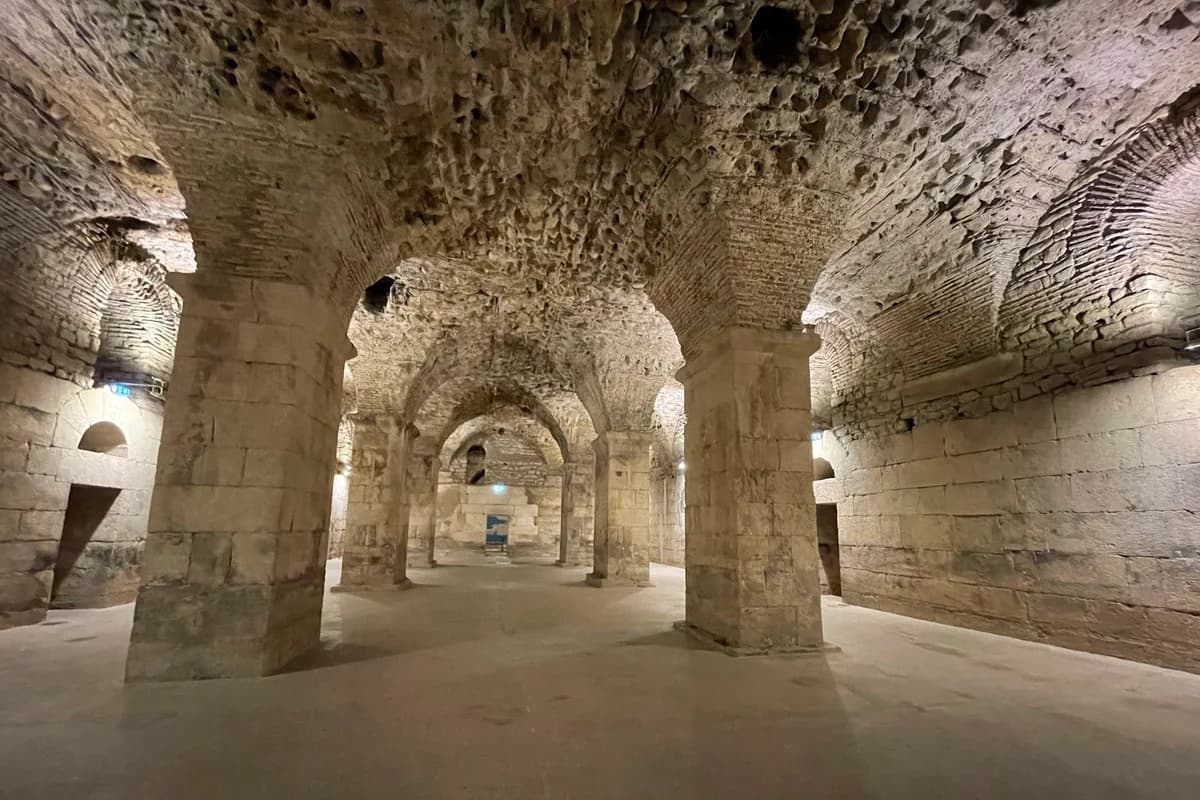
The Southern Half (Imperial Residential and Sacred Complex): Anchored by the Peristyle—a monumental open courtyard flanked by granite Corinthian columns where, for the first time in classical architecture, arches sprang directly from column capitals without an intervening entablature (archivolts),foreshadowing medieval Romanesque design. East of the Peristyle stood the octagonal Emperor’s Mausoleum encircled by a peripteral colonnade of 24 columns; to the west stood the Temple of Jupiter(today the Baptistery of St. John) alongside two smaller circular temples dedicated to Cybele and Venus.South of the Peristyle, a domed circular Vestibule led into the private imperial apartments (audience basilica, triclinium dining hall, private baths, and residential suites), whose exact floor plan is preserved beneath them in the monumental vaulted Substructures (Cellars) of Diocletian’s Palace, engineered to elevate the residential level above the sloping coastal terrain.
Abdication, the Conference of Carnuntum, and Death
On May 1, 305 AD, in Nicomedia, Diocletian performed an unprecedented act in Roman imperial history—voluntarily abdicating his throne and retiring to his palace in Aspalathos.
When the Tetrarchy subsequently fractured into civil war, his co-rulers implored him at the Conference of Carnuntum in 308 AD to reclaim the purple. As recorded by the historian Aurelius Victor, Diocletian declined with the famous words:
"If you could see at Salona the cabbages which I have planted with my own hands, you would never urge me to trade such peace for the storms of insatiable greed for power."
Diocletian died inside the palace (between 311 and 316 AD) and was interred in a porphyry sarcophagus within his mausoleum. Throughout the 4th and 5th centuries, the palace remained state property of the Roman court, serving as a residence for exiled imperial family members. From 475 to 480 AD, it served as the final seat of Julius Nepos, the last legitimate Emperor of the Western Roman Empire recognized by Constantinople, who was assassinated inside the palace in 480 AD.
From Palace to City: The Early Middle Ages (7th–11th Centuries)
The definitive transformation of the imperial residence into a living urban commune occurred during the first half of the 7th century, amidst the Great Migration Period.
The Fall of Salona and the Refuge in the Palace
Around 614 AD (or toward the mid-7th century according to modern archaeological revisions), Avar and Slavic incursions overwhelmed the defenses of Salona. The metropolis was sacked and burned, prompting the surviving Romanized population to flee to the offshore islands of Brač, Šolta, Hvar, and Vis.
According to the 13th-century chronicle Historia Salonitana (History of the Bishops of Salona and Split) authored by Thomas the Archdeacon (Toma Arhiđakon, 1200–1268), several decades later a prominent Salonitan patrician named Severus the Great (Severus Magnus) organized the return of the island refugees to the mainland. Because the vast perimeter of ruined Salona could no longer be defended, the returnees settled inside the fortified stone walls of Diocletian’s Palace:
Wealthy patricians claimed the grand halls and upper chambers,
Poorer citizens constructed wooden dwellings across courtyards, porticoes, basement substructures, and even inside the hollow defensive towers.
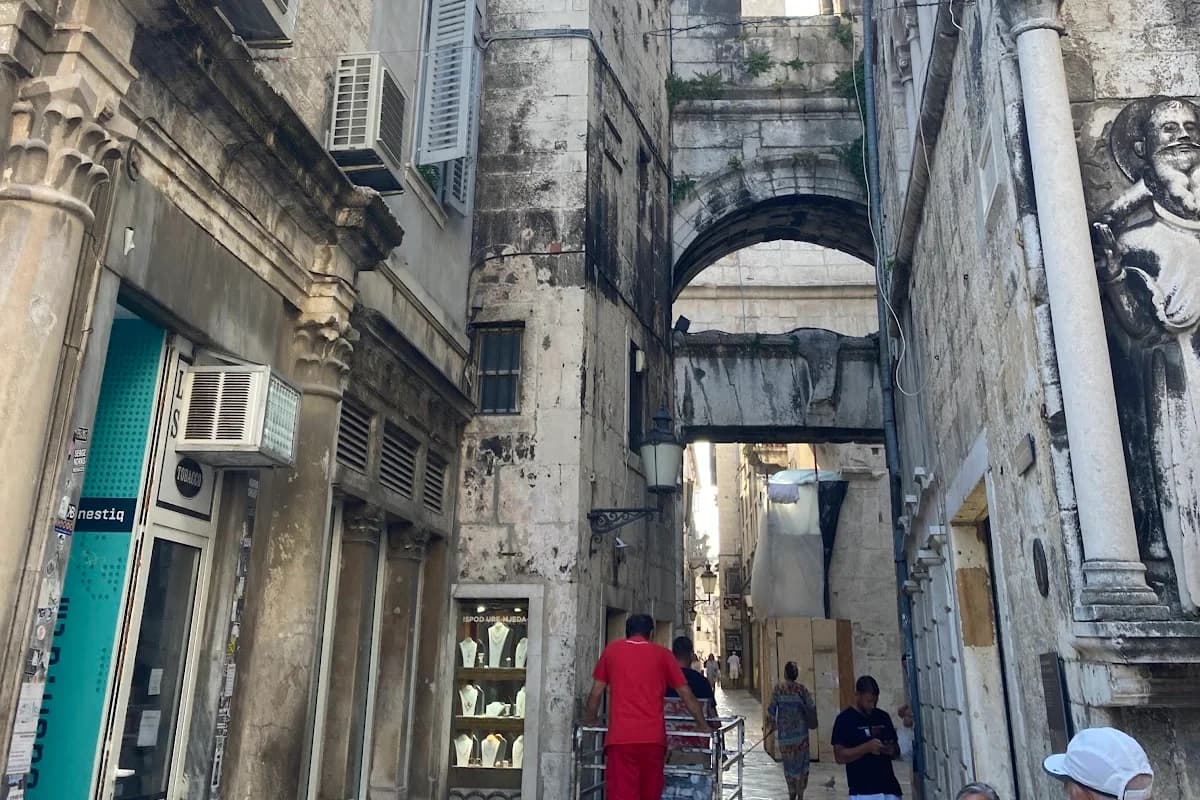
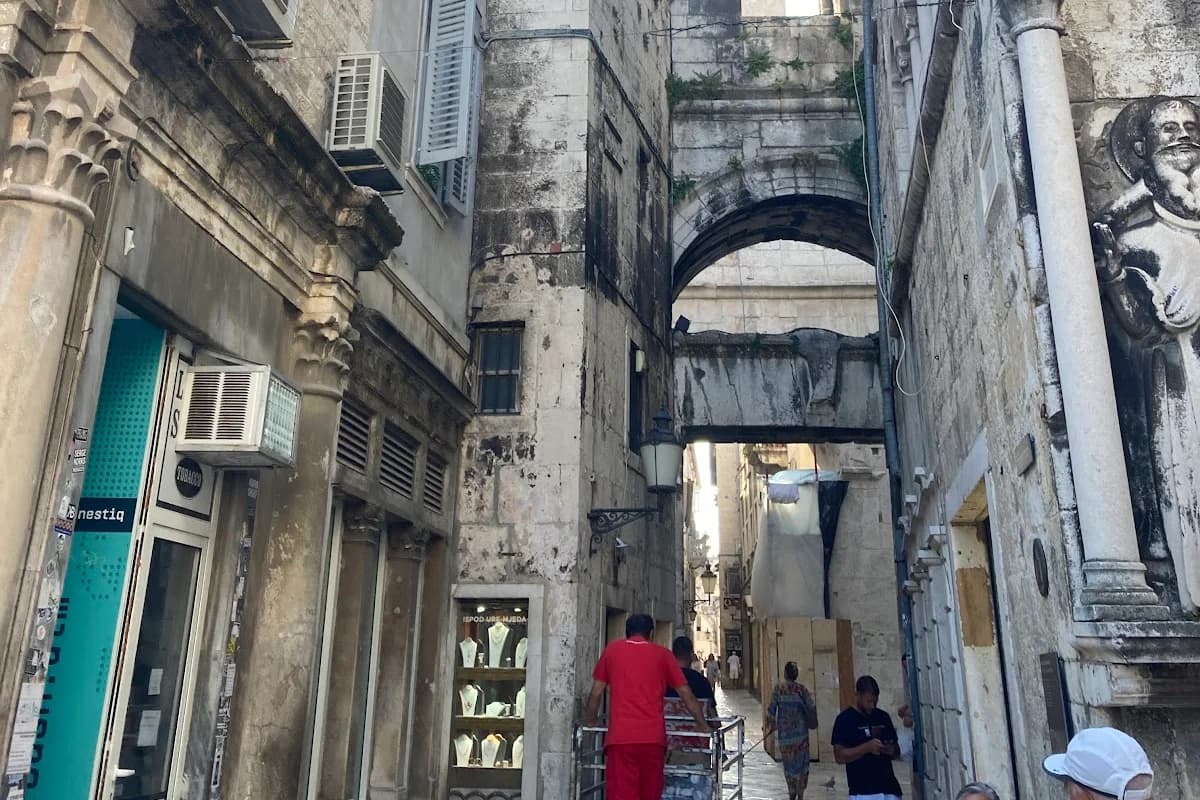
This inaugurated a remarkable process of adaptive urbanism: vast imperial halls were subdivided into smaller residential units, the open arches of the Peristyle and the southern seafront facade were walled in to create living quarters, and broad Roman avenues narrowed into medieval streets (kale).
John of Ravenna and the Christianization of the Palace
Around 650 AD, the papal legate John of Ravenna (Ivan Ravenjanin) was elected the first Archbishop of Split,formally transferring the metropolitan authority and ecclesiastical jurisdiction of ruined Salona to the new city inside the palace.
John of Ravenna executed the physical and spiritual Christianization of the imperial complex:
He purged Diocletian’s Mausoleum of pagan idols and the emperor's sarcophagus, consecrating the octagonal structure to the Assumption of the Virgin Mary—transforming the tomb of the great persecutor of Christians into the Cathedral of Split (Cathedral of Saint Domnius).
From the ruined basilicas of Salona, he solemnly translated the sacred relics of the martyrs Saint Domnius (Sveti Dujam) and Saint Anastasius (Sveti Staš) into the cathedral.
He converted the pagan Temple of Jupiter into the Baptistery of Saint John the Baptist.
Byzantine Dalmatia and Relations with Early Croatian Rulers
Throughout the Early Middle Ages, Split was part of the Byzantine province (Thema) of Dalmatia, enjoying broad municipal autonomy. The city functioned as a Romance-speaking urban enclave surrounded by the early medieval Croatian principality (and later kingdom) ruled by the Trpimirović dynasty from nearby royal seats in Klis, Solin, and Bijaći.
Interactions between Roman Split and its Croatian hinterland were deeply intertwined:
Duke Trpimir (845–864) and Duke Branimir maintained close ecclesiastical and diplomatic ties with the clergy of Split.
In 925 and 928, the historic Church Councils of Split convened inside the cathedral in the presence of the Croatian King Tomislav and Prince Michael of Zahumlje. These synods confirmed the Archbishop of Split as the ecclesiastical metropolitan over the entire territory from the Adriatic to the Drava River (abolishing the Diocese of Nin led by Bishop Gregory of Nin), while regulating the use of the Slavic language and Glagolitic script in liturgy in favor of Latin.
During the 11th century, under Kings Peter Krešimir IV and Demetrius Zvonimir (who was crowned in 1075 at the Basilica of Saints Peter and Moses in nearby Solin by the papal legate Gebizo), Croatian demographic and linguistic influence steadily integrated into Split. From this era dates the famous pre-Romanesque stone altar screen pluteus in the Split Baptistery featuring the carved relief of an enthroned Croatian king.
The High Middle Ages: An Autonomous Commune Between Hungary and Venice (1102–1420)
Following Croatia’s entry into a personal union with the Kingdom of Hungary in 1102, King Coloman marched to the gates of Split. After a brief siege, the citizens negotiated a peaceful surrender on the condition that the king ratify their ancient municipal liberties (privilegia), grant tax exemptions, and uphold their right to independently elect their count and archbishop.
Urban Expansion Beyond the Palace Walls
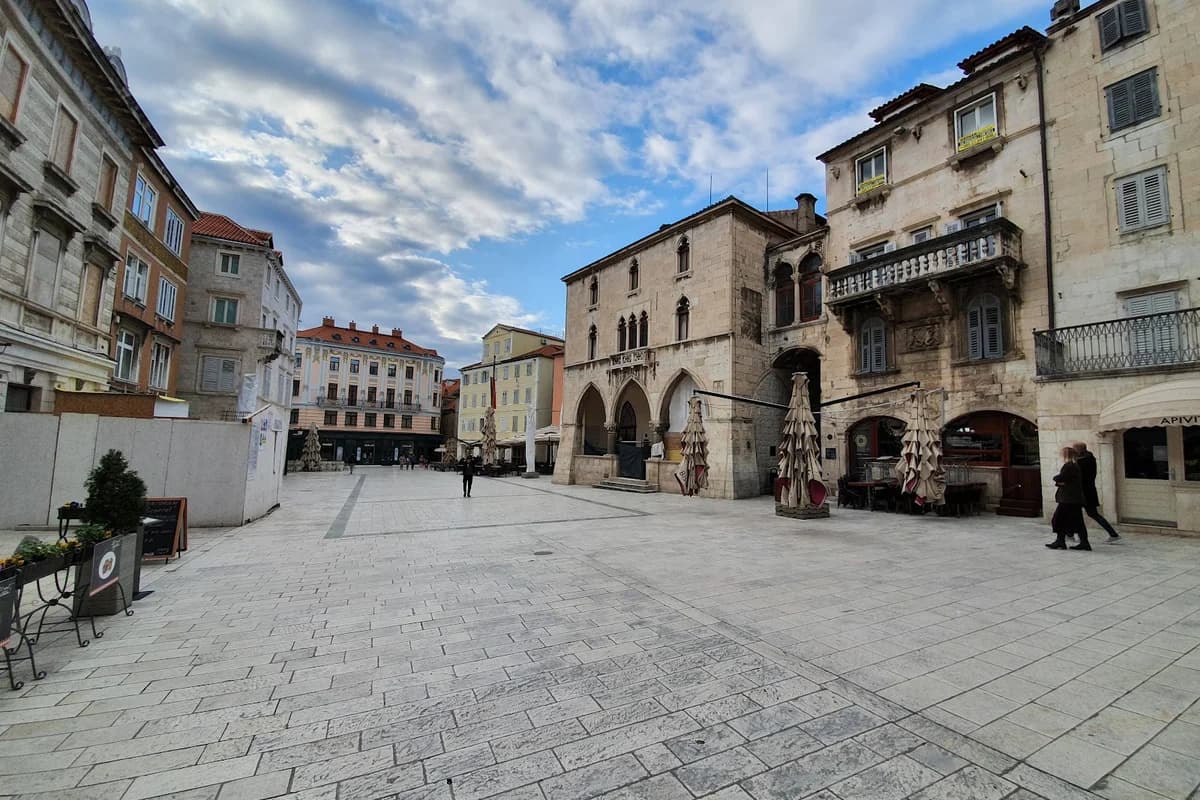
As the population expanded, the confines of Diocletian’s walls proved insufficient. The city expanded westward beyond the Iron Gate, forming the New Town (Burgus or Civitas nova) centered around a new public square—the Pjaca (St. Lawrence’s Square, today People’s Square / Narodni trg).
During the 13th and 14th centuries, this western borough was enclosed within new medieval defensive walls, doubling the fortified area of Split. Around the Pjaca rose noble Gothic palaces (such as the Cipci and Karepić palaces) alongside the complex of the Old Town Hall and the Rector’s Palace.
The Cultural and Artistic Flowering of the 13th Century
The 13th century marked a golden age of medieval institutional and artistic achievement in Split:
Master Buvina (1214): The local sculptor and woodcarver Andrija Buvina carved the monumental walnut doors of Split Cathedral. Across the two door leaves, he sculpted 28 relief panels depicting the life and passion of Jesus Christ framed by intricate Romanesque scrollwork—recognized today as one of the finest surviving examples of Romanesque woodcarving in Europe.
The Bell Tower of Saint Domnius: Construction began on the iconic Romanesque-Gothic cathedral campanile around the mid-13th century (sponsored by King Béla IV and Queen Maria Laskaris, and completed in the 16th century), engaging master stonemasons including Master Otto and followers of Master Radovan.
The Statute of Split (1312): To curb factional strife among noble families, the commune appointed an external podestà (chief magistrate), the Italian jurist Perceval of Fermo. In 1312, he codified the Statute of Split—a comprehensive six-book legal code regulating constitutional governance, civil, criminal, and maritime law, as well as urban sanitation, building codes, and public order.
The Era of the Šubić Noble Family and Duke Hrvoje Vukčić Hrvatinić
Throughout the 13th and 14th centuries, Split navigated shifting regional hegemonies to preserve its civic autonomy:
At the turn of the 14th century, the city was governed by the powerful Croatian magnates, the Šubić Princes of Bribir (Ban Paul I and Mladen II).
Following the Treaty of Zadar (1358), Split prospered under the rule of the Angevin King Louis I the Great.
At the dawn of the 15th century, amid dynastic wars between Sigismund of Luxembourg and Ladislaus of Naples, King Ladislaus appointed the powerful Bosnian Grand Duke Hrvoje Vukčić Hrvatinić as Duke of Split(dux Spalati, 1403–1413). Hrvoje governed as virtual sovereign, minted his own silver coinage in Split, and commissioned the richly illuminated Glagolitic Missal of Duke Hrvoje for the church of Split.
Four Centuries Under the Winged Lion of Venice (1420–1797)
After King Ladislaus of Naples sold his dynastic rights to Dalmatia to the Republic of Venice for 100,000 ducats in 1409, Venetian naval squadrons systematically subjugated the coastal communes. On June 29, 1420, facing a naval blockade led by Admiral Pietro Loredan, Split surrendered to Venice, inaugurating a period of Venetian rule that lasted 377 years.
Loss of Political Autonomy and Mercantilist Restrictions
Integrated into the Venetian maritime empire (Stato da Màr), Split lost its sovereign status:
Municipal governance was placed under a Venetian patrician holding the title of Count-Captain (conte e capitano), appointed directly by the Great Council in Venice.
Venice enforced strict commercial protectionism: all overseas maritime trade was required to pass through Venice, curbing the independent shipping fleet of Split.
Local council seats were restricted to a closed oligarchy of noble families (Veliko vijeće), generating persistent class friction with wealthy commoners (građani) and artisans/peasants (pučani) residing in the growing suburbs of Veli Varoš, Dobri, Manuš, and Lučac.
Humanism, the Renaissance, and Marko Marulić
Despite political subordination and mounting Ottoman pressure, the 15th and 16th centuries produced an extraordinary flowering of Renaissance architecture, humanism, and literature:
Giorgio da Sebenico (Juraj Dalmatinac): The celebrated Renaissance architect and sculptor worked in Split during the mid-15th century. Inside the Cathedral of St. Domnius, he sculpted the late-Gothic masterpiece Chapel and Altar of Saint Anastasius (1448), featuring a dramatic relief of the Flagellation of Christ. Within the palace core, he designed the Great Papalić Palace in the flamboyant Gothic-Renaissance style (today housing the City Museum of Split).
Andrea Alessi (Andrija Aleši): Collaborator of Juraj Dalmatinac who executed refined Renaissance sculptural works in the Baptistery and local churches.
Marko Marulić (1450–1524) and the Split Humanist Circle: Gathering inside the courtyard of the Papalić Palace, a circle of classical scholars (including Dmine Papalić, Frane Božičević Natalis, and Toma Niger) studied Roman epigraphy and classical literature. The central figure of this circle was the Split nobleman Marko Marulić, revered as the Father of Croatian Literature. While Ottoman cavalry raided the Split plains up to the city walls, Marulić composed the biblical epic poem Judita in 1501 (printed in Venice in 1521)—the first major literary work written in the Croatian language (Split Chakavian dialect)—crafted to inspire moral resilience among his fellow citizens. His Latin moral and theological treatises (De institutione bene vivendi,Evangelistarium) became European bestsellers, translated into numerous languages and read by figures such as King Henry VIII and Thomas More.
Ottoman Sieges, the Fall of Klis, and Baroque Bastion Fortifications
In the early 16th century, the Ottoman Empire conquered the entire Split hinterland. Following a heroic defense led by Captain Petar Kružić, the strategic Fortress of Klis fell to the Ottomans in March 1537. The imperial border dropped directly into the Split field, just kilometers from Diocletian’s walls (with Ottoman forts established at Solin and Kamen).
Reduced to a besieged coastal strip, Split’s strategic vulnerability became critical during the Cretan War (1645–1669).After Venetian forces supported by local volunteers under General Leonardo Foscolo liberated Klis in 1648, Venice transformed Split into a modern baroque fortress engineered according to the trace italienne system:
Directed by military engineer Alessandro Magli, a perimeter ring of massive stone-and-earth bastions linked by curtain walls was erected around the medieval city: the Priuli, Cornaro (Contarini), Bernardi, Moro, and Bembo bastions.
On the strategic elevation of Gripe east of the city, a standalone star-shaped artillery fortress was constructed to command the landward approaches.
The Split Port of Trade (Scala di Spalato) and the Lazaretto (1592)
Amid centuries of warfare, an economic initiative revitalized the city. Spearheaded by Daniel Rodriguez (Danijel Rodriga), an enterprising Sephardic Jew living in Split, the Venetian Senate approved the construction of a free transit port and quarantine complex in Split.
In 1592, the Split Emporium (Scala di Spalato) and Lazaretto officially opened along the eastern harbor shore:
Strategic Function: To bypass pirate raids by the Uskoks of Senj along the Adriatic sea lanes, overland caravan trade linking the Ottoman Empire (Bosnia, Serbia, Bulgaria, the Levant, and Persia) with Venice was funneled directly to Split.
Commercial Scale: Caravans numbering hundreds of packhorses arrived at the gates of Split bearing hides,wool, beeswax, silk, spices, cotton, and iron. Inside the expansive Split Lazaretto (one of the largest and best-organized quarantine facilities in the Mediterranean), merchandise was disinfected via smoke fumigation, and merchants underwent mandatory medical quarantine against the bubonic plague before loading goods onto armed Venetian galleys.
Spurred by this commercial boom, Split established its first public bank in 1590, while the Jewish community became an integral pillar of urban life (founding the Jewish Ghetto inside the northwestern quadrant of the Palace, housing one of the oldest continuously operating synagogues in Europe).
Despite strict quarantine protocols, plague epidemics periodically breached the city: the catastrophic plague of 1607decimated nearly three-quarters of Split's population (leaving barely 1,500 survivors), with severe outbreaks recurring in 1731, 1763, and 1784. Following the Venetian-Austrian victories in the Morean War (Treaty of Karlowitz, 1699) and the Treaty of Passarowitz (1718), the Ottoman frontier was pushed permanently inland beyond Sinj and Imotski,allowing Split to expand peacefully alongside its agricultural suburbs of Veli Varoš, Lučac, Dobri, and Manuš.
Rediscovering Split for Europe: Robert Adam (1764)
During the Enlightenment, Diocletian’s Palace captured the imagination of European architects. In 1757, the Scottish architect Robert Adam, accompanied by the French artist Charles-Louis Clérisseau, spent five weeks surveying and sketching the ancient ruins of Split.
In 1764, Adam published his monumental folio in London: Ruins of the Palace of the Emperor Diocletian at Spalatro in Dalmatia. The volume caused an immediate sensation across Europe, directly inspiring the Neoclassical movement (Adam style) in Great Britain, Russia, and North America, and placing Split on the itinerary of European Grand Tour travelers.
The Nineteenth Century: Napoleon, Habsburg Rule, and the Croatian National Revival (1797–1918)
With the fall of the Republic of Venice in May 1797 (Treaty of Campo Formio), Split entered a turbulent 19th century defined by shifting imperial administrations and the struggle for national emancipation.
French Rule and Marshal Marmont (1806–1813)
Following a brief first Austrian administration (1797–1805), the Treaty of Pressburg awarded Dalmatia to Napoleon’s French Empire. French governance in Split was directed by General (later Marshal) Auguste de Marmont.
Though lasting only seven years, French administration initiated sweeping urban and social modernization:
Dismantling Venetian Fortifications: Marmont ordered the demolition of sections of the medieval walls and baroque bastions to open the city and connect the historic core with its suburbs.
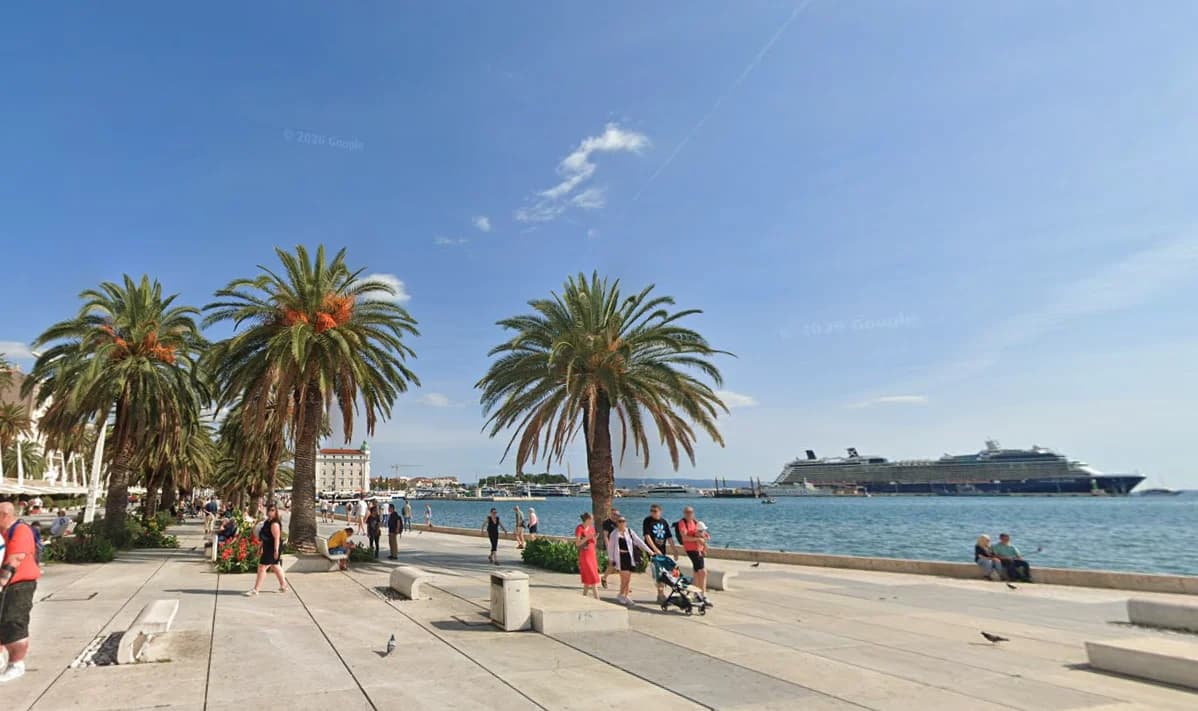
Creation of the Riva: By filling in the shoreline along the southern facade of the Palace, the French created a wide, palm-lined seafront promenade—today’s iconic Split Riva.
Public Parks and Civil Reform: On the site of the leveled Cornaro bastion, the first public municipal park in Dalmatia was laid out; noble feudal privileges were abolished, civil equality before the law was introduced, and modern secular schools were opened.
Second Austrian Rule and the Political Struggle: Narodnjaci vs. Autonomaši
Following Napoleon's defeat and the Congress of Vienna (1815), Split was incorporated into the Habsburg Monarchy (Austrian Empire) within the Crown Land of the Kingdom of Dalmatia, administered from Zadar. In 1828, the papal bull Locum beati Petri downgraded the ancient Archdiocese of Split to a regular diocese subordinate to Zadar—a move deeply resented by the citizens of Split.
In the second half of the 19th century, Split became the epicenter of a fierce political struggle between two opposing movements:
The Autonomists (Autonomaši): Led by the charismatic Mayor of Split, Dr. Antonio Bajamonti (who governed from 1860 to 1880). They championed an autonomous "Slavo-Dalmatian" regional identity tied to Italian cultural traditions, maintained Italian as the language of administration, and opposed the unification of Dalmatia with northern Croatia. Bajamonti was simultaneously an ambitious urban builder: he introduced gas street lighting, reconstructed the ancient Roman aqueduct (1880), erected a grand theater (Teatro Bajamonti),initiated the Neo-Renaissance Prokurative square (Republic Square), and built the monumental marble fountain (Fontana Bajamonti) on the Riva.
The National Party (Narodnjaci): Led by Gajo Bulat, Mihovil Pavlinović, Natko Nodilo, and Vid Morpurgo. They campaigned for the introduction of the Croatian language into schools, courts, and municipal government, and advocated the political reunification of Dalmatia with Croatia and Slavonia. They established the Slavonic Reading Room (Slavjanska narodna čitaonica), Vid Morpurgo’s bookstore, and the influential newspaper Il Nazionale (Narodni list).
The Historic Victory of 1882: Croatization of the Municipality
After decades of political tension and street clashes, the National Party won a landslide victory in the municipal elections of October 1882.
On October 28, 1882, the first Croatian municipal council was inaugurated under Mayor Dr. Dujam Rendić-Miočević, succeeded shortly thereafter by Dr. Gajo Bulat. Croatian was officially adopted as the language of the Municipality of Split, ending centuries of Italian-speaking political dominance in Dalmatia’s largest city. In 1893, the new building of the Croatian National Theatre in Split was solemnly inaugurated.
Fin-de-Siècle Economic and Cultural Expansion
At the turn of the 20th century, Split surpassed Zadar as the economic engine of Dalmatia:
A modern stone breakwater (Điga) was constructed to shelter the harbor,
In 1877, the first railway line connecting Split to Siverić and Šibenik opened,
Utilizing abundant local marl deposits, major Portland cement factories (Gilardi & Bettiza, Prva dalmatinska) were founded in Split, Solin, and Kaštela, launching the city's industrial era,
In 1903, Dr. Juraj Kolombatović and the Marjan Society initiated the systematic afforestation of barren Marjan Hill with Aleppo pines, creating the city's beloved forest park,
In 1911, Split students studying in Prague founded the football club HNK Hajduk Split, which rapidly grew into a powerful symbol of civic and regional identity.
The Twentieth Century: Wars, Modernization, and the Urban Boom
The 20th century brought dramatic geopolitical upheavals alongside an unprecedented demographic expansion that transformed Split from a town of twenty thousand residents into a major Mediterranean metropolis.
World War I and the Interwar Boom (1914–1941)
During World War I, Split endured strict Austro-Hungarian military rule, Allied naval blockades, and severe food shortages.
Following the collapse of Austria-Hungary in autumn 1918 and the signing of the Treaty of Rapallo (1920)—which ceded Istria, the former capital Zadar, and several islands to Italy—Split became the undisputed administrative, economic, cultural, and maritime capital of the entire Croatian littoral within the newly formed Kingdom of Serbs,Croats, and Slovenes (later Yugoslavia):
Capital of the Littoral Banovina (Primorska banovina, 1929–1939): Split was designated the administrative seat of the Littoral Banovina under Ban Dr. Ivo Tartaglia. During his tenure, the city constructed the monumental Banovina administrative palace on the West Coast, the Public Health Institute, the Oceanographic Institute on Marjan, the Fine Arts Gallery, modernized the hospital, and electrified the city via the Kraljevac hydroelectric plant on the Cetina River.
Rail Connectivity and Shipbuilding: The completion of the Lika Railway in 1925 directly linked Split by rail to Zagreb and Central Europe for the first time. Split became the busiest export port in the state (shipping cement, bauxite, and timber), and in 1931, Franco-Yugoslav capital consolidated local shipyards in the Supaval cove into the modern Brodosplit shipyard.
In August 1939, under the Cvetković–Maček Agreement, Split was integrated into the autonomous Banovina of Croatia.
World War II: Italian Occupation and Anti-Fascist Resistance (1941–1945)
Following the Axis invasion of Yugoslavia in April 1941, Ustaše leader Ante Pavelić signed the Treaties of Rome on May 18, 1941, ceding central Dalmatia—including the city of Split—directly to Benito Mussolini’s Fascist Italy.
Resistance to Annexation: The population of Split met Italian annexation and forced Italianization with immediate, widespread resistance. In August 1941, young volunteers formed the First Split Partisan Detachment (largely composed of players from RNK Split and local youth, who were captured and executed at Ruduša near Sinj). The entire squad of HNK Hajduk refused an offer to compete in the Italian first division (Serie A) under the name AC Spalato in exchange for financial privileges; in 1944, the players escaped to the liberated island of Vis, reconstituting the club as the official team of the anti-fascist liberation movement (later honored by General Charles de Gaulle as the "Honorary Team of Free France").
Capitulation of Italy, Allied Bombings, and Liberation: Upon the capitulation of Italy on September 8, 1943,Partisan forces and citizens briefly liberated Split for seventeen days before German Wehrmacht and Prinz EugenSS units occupied the city following fierce battles around Klis. Throughout 1944, Split suffered heavy Allied aerial bombardments targeting German port installations (most severely on June 3, 1944), which killed over 300 civilians and damaged the harbor, Pazar, and the southern wall of the Palace.
Liberation: On October 26, 1944, units of the 26th Dalmatian Division liberated Split from German occupation.On April 14, 1945, inside the Old Town Hall on the Pjaca, the first People's Government of Federal Croatiawas formally established.
Socialist Industrialization, "Split 3," and the Mediterranean Games (1945–1990)
During the second half of the 20th century, Split experienced massive spatial, industrial, and demographic expansion.Drawn by industrial jobs, migrants from the Dalmatian hinterland (Zagora) and the islands quadrupled the city's population from 50,000 in 1945 to nearly 200,000 by 1990.
Industrial Giants: The Split and Kaštela basin became a premier industrial powerhouse. Shipyard "Split" (Brodosplit) ranked among the leading shipbuilders in the world, employing over 7,000 workers. Alongside it operated manufacturing giants such as Jugoplastika (employing over 12,000 workers producing footwear,apparel, thermoplastics, and automotive components), Dalmacijavino, Dalmacija Cement, and metallurgical plants. In 1974, the University of Split was officially founded.
Project "Split 3" — A Masterpiece of Late-Modernist Urbanism: To house tens of thousands of new residents, the city launched the Split 3 urban megaproject in 1968 (encompassing the districts of Blatine-Škrape,Lokve, Gripe, Trstenik, and Mertojak for 50,000 inhabitants). Based on the master plan by Slovenian urbanists Vladimir Braco Mušič, Marjan Bežan, and Ninoslav Kučan, and residential architecture by Split architects (Dinko Kovačić, Frano Gotovac, Ivo Radić), Split 3 blended high-density brutalist/modernist housing with human-scale Mediterranean pedestrian streets (Ruđer Bošković Street) modeled after the ancient Roman decumanus. Split 3 achieved global architectural acclaim and was prominently featured at the Museum of Modern Art (MoMA) in New York.
The 8th Mediterranean Games (MIS 1979): Hosting the 1979 Mediterranean Games triggered a comprehensive infrastructural transformation of Split:
Construction of the iconic Poljud City Stadium (designed by architect Boris Magaš), an engineering landmark featuring a shell-shaped suspended roof structure,
The Poljud indoor swimming complex and the Gripe Sports Center,
A subterranean railway tunnel beneath the city center and the Marjan road tunnel,
A new terminal at Split Airport in Resnik and modernized hotel capacities.
UNESCO World Heritage Inscription: In that same year, 1979, the Historical Complex of Split with the Palace of Diocletian was inscribed on the UNESCO World Heritage List.
Contemporary Split: The Homeland War and Rise as a Tourist and Academic Hub (1991–Present)
Following democratic changes in 1990 and the breakup of Yugoslavia, Split played a pivotal role in the defense of Croatian independence during the Homeland War (1991–1995).
Split in the Homeland War
Protest Before the Banovina (May 6, 1991): Tens of thousands of shipyard workers and citizens gathered outside the Yugoslav Navy (JRM) command headquarters in the Banovina building to protest the blockade of the Croatian village of Kijevo.
The 4th Guards Brigade ("The Spiders"): Founded in Split on April 28, 1991, the legendary 4th Guards Brigade became one of the elite strike formations of the Croatian Army, playing a decisive role in liberating the Dubrovnik hinterland, the Maslenica gorge, and executing Operation Storm (Oluja) in August 1995.
The Battle of the Split Channel (November 14–15, 1991): In autumn 1991, warships of the Yugoslav Navy led by the destroyer VPBR-31 Split imposed a naval blockade on the city. Following a Croatian saboteur attack on a patrol boat, on the morning of November 15, 1991, the Yugoslav fleet opened artillery fire directly on central Split, damaging the Archaeological Museum, municipal buildings, civilian ferries, and residential quarters,killing two ferry crewmen. Coastal artillery batteries of the fledgling Croatian Navy positioned on Split, Brač,and Šolta returned fire, scoring direct hits on the warships and driving the Yugoslav fleet permanently out of the Split Channel and the central Adriatic. Throughout the war, Split provided shelter to tens of thousands of displaced persons from occupied Croatian territories and Bosnia and Herzegovina.
Post-War Transition and the 21st-Century Renaissance
The 1990s and early 2000s brought painful deindustrialization: market disruptions and flawed privatizations led to the collapse of industrial giants such as Jugoplastika, Dalmacijavino, and Jadrantekstil, while shipbuilding underwent protracted restructuring.
In the 21st century, Split executed a complete economic and urban pivot:
Mediterranean Tourism and Maritime Boom: Catalyzed by the completion of the A1 motorway (Zagreb–Split) in 2005 and the renovation of the Riva (2007) and West Coast promenade, Split transformed from a transit ferry hub into a premier global destination. Today, the Port of Split is the busiest passenger ferry port on the Adriatic and the third busiest in the entire Mediterranean (handling over 5.5 million passengers annually).
Academic and Technology Hub: Centered around its modern campus in Visoka, the University of Spliteducates over 20,000 students and consistently ranks among the top scientific universities in Southeastern Europe, fostering a growing local IT and technology ecosystem.
Global Sporting Phenomenon: Often dubbed "the sportiest city in the world" per capita, Split has produced athletes who have won nearly a hundred Olympic medals (including Goran Ivanišević, Toni Kukoč, Dino Rađa,Blanka Vlašić, Đurđica Bjedov, and the Sinković/Skelin rowers), alongside legendary European champion clubs such as KK Split / Jugoplastika (three-time consecutive European basketball champions, 1989–1991), water polo champions VK Jadran, VK Mornar, and VK POŠK, and the enduring civic passion for HNK Hajduk.
Chronological Overview of Key Milestones in the History of Split
Year / Era | Historical Event and Urban-Social Significance |
|---|---|
4th–1st c. BC | The Illyrian-Greek settlement and harbor of Aspalathos operates on the Split peninsula. |
1st c. BC | Julius Caesar elevates nearby Salona to the status of a Roman colony (Colonia Martia Iulia Salona), metropolis of Dalmatia. |
295–305 AD | Roman Emperor Diocletian constructs his monumental fortified palace in Aspalathos and a 9 km aqueduct from the Jadro River. |
304 AD | During Diocletian's persecutions, Salonitan Bishop Saint Domnius (Sveti Dujam) is martyred in the Salona amphitheater. |
May 1, 305 AD | Emperor Diocletian voluntarily abdicates the throne and retires to his palace in Split, where he resides until his death. |
480 AD | Julius Nepos, the last legitimate Emperor of the Western Roman Empire, is assassinated inside Diocletian’s Palace. |
c. 614–640 | Ancient Salona is sacked by Avars and Slavs; surviving refugees led by Severus the Great settle inside the fortified Palace. |
c. 650 | First Archbishop John of Ravenna converts Diocletian’s Mausoleum into a cathedral and translates the relics of St. Domnius. |
925 & 928 | Church Councils of Split convene during the reign of King Tomislav; the Archbishop of Split becomes metropolitan of Croatia. |
1102 | Hungarian-Croatian King Coloman confirms Split’s municipal autonomy; the city expands westward outside the walls (the Pjaca). |
1214 | Master Andrija Buvina carves the monumental wooden Romanesque doors of Split Cathedral featuring 28 relief panels. |
1266 | Death of Thomas the Archdeacon, author of Historia Salonitana, the foundational chronicle of medieval Dalmatia. |
1312 | Podestà Perceval of Fermo codifies the Statute of Split. |
1403–1413 | Bosnian Grand Duke Hrvoje Vukčić Hrvatinić rules the city as "Duke of Split" (dux Spalati) and mints his own silver coins. |
June 29, 1420 | Split comes under the rule of the Republic of Venice, which governs the city for the next 377 years (until 1797). |
1501 (pr. 1521) | Split humanist Marko Marulić completes the epic poem Judita, the first major literary work in the Croatian language. |
1537 | Fortress Klis falls to the Ottoman Empire; Split becomes a frontline border city facing Ottoman territory. |
1592 | Initiated by Daniel Rodriguez, the Split Emporium (Scala) and Lazaretto open, linking Balkan trade routes with Venice. |
1607 | A catastrophic bubonic plague epidemic claims nearly three-quarters of Split's population. |
1648–1669 | During the Cretan War, Klis is liberated; Venice surrounds Split with baroque artillery bastions and the Gripe Fortress. |
1764 | Scottish architect Robert Adam publishes his monograph on Diocletian's Palace in London, inspiring European Neoclassicism. |
1806–1813 | French Rule (Marshal Marmont); walls are partially dismantled and the palm-lined Split Riva promenade is created. |
Oct 28, 1882 | Victory of the National Party (Narodnjaci) in municipal elections; Croatian becomes the official language of Split. |
1911 | Founding of the football club HNK Hajduk Split. |
1925 | Opening of the Lika Railway, establishing the first direct rail connection between Split and Zagreb. |
1929–1939 | Split serves as the capital of the Littoral Banovina (Primorska banovina); rapid modernization under Ban Ivo Tartaglia. |
1941–1944 | World War II: Italian annexation and German occupation met by mass anti-fascist resistance; liberated on October 26, 1944. |
1968–1979 | Construction of the modernist urban megaproject Split 3 amid rapid industrial and demographic growth. |
1979 | Split hosts the 8th Mediterranean Games (Poljud Stadium built); Diocletian’s Palace inscribed on the UNESCO World Heritage List. |
Nov 15, 1991 | Battle of the Split Channel: Croatian coastal artillery defeats and expels the Yugoslav Navy fleet after the shelling of Split. |
2005 | Completion of the A1 motorway (Zagreb–Split); catalyst for Split's rise as a premier Mediterranean tourism and university hub. |
Authoritative Historical, Archaeological, and Archival References
City Museum of Split (MGS) – The central municipal museum housed in the Gothic-Renaissance Papalić Palace,preserving civic heritage from the Middle Ages to the modern era.
Archaeological Museum in Split (AMS) – Founded in 1820 as the oldest museum institution in Croatia,managing the collections of ancient Salona, Issa, and Diocletian's Palace.
Museum of Croatian Archaeological Monuments in Split (MHAS) – National museum dedicated to early medieval Croatian stone epigraphy, royal inscriptions, and archaeological heritage.
State Archives in Split (DAST) – Repository preserving original Venetian, French, and Austro-Hungarian administrative records, municipal statutes, and notarial books.
UNESCO World Heritage Centre – Historical Complex of Split with the Palace of Diocletian – Official international documentation regarding the conservation and universal value of the historic core.
Literary Circle Split – Marulianum – Academic research center dedicated to Marko Marulić, Renaissance humanism, and scholarly publications on Split’s urban history.
Miroslav Krleža Institute of Lexicography – Croatian Encyclopedia: Split – Comprehensive scholarly synthesis of the city's historical, demographic, and architectural evolution.